
In vitro Evaluation of the Anti-Inflammatory Activity of Herbal Mixtures Containing Carica papaya, Azadirachta indica, and Allium sativa
-
Michael Sunday Abu

Department of Biochemistry, Federal University Wukari, Taraba State, Nigeria
Ojochenemi Ejeh YakubuDepartment of Biochemistry, Federal University Wukari, Taraba State, Nigeria
Silas Verwiyeh TatahDepartment of Biochemistry, Federal University Wukari, Taraba State, Nigeria
Yab Jeremiah DankaDepartment of Science Laboratory Technology, Federal Polytechnic Ugep, Cross River State, Nigeria
| Received 04 Jan, 2026 |
Accepted 02 Jun, 2026 |
Published 21 Jun, 2026 |
Background and Objective: Inflammation is a natural defense response to tissue damage brought on by toxic substances and physical trauma. Non-Steroidal Anti-Inflammatory Drugs (NSAIDs) are the most widely used medications for the treatment of inflammatory disorders; nevertheless, they have several side effects, particularly stomach irritation, which can result in the development of gastric ulcers. The in vitro anti-inflammatory potential of herbal mixture of Carica papaya, Azadirachta indica and Allium sativa was investigated in the present research. Materials and Methods: The collected plant materials were rinsed in clean water air-dried at room temperature under the shade to constant weight and pulverized into powder. The herbal formulation was made by combining the pulverized samples of Carica papaya, Azadirachta indica and Allium sativa parts in the ratios (1:1:1, 2:1:1, 1:2:1 and 1:1:2 w/w), respectively to obtain four permutations of the herbal mixture. Exactly 500 g of each of the herbal formulated ratio was extracted in 2.5 L of absolute ethanol and evaluated for membrane stabilization activity and inhibition of albumin denaturation at different concentrations, 100, 200, 300 and 400 μg/mL. Results: The results of in vitro anti-inflammatory potential revealed that the various ratios of the herbal formulation perform relatively close in both egg albumin denaturation and heat induced membrane stability ability. Although, C-2:1:1 ratio at 400 μg/mL has higher protein denaturation percent (78.53%) while B-1:1:2, C-2:1:1 and D-1:2:1 were at pal in the heat induced membrane stability potential (79.78, 79.34 and 80.82, respectively). Conclusion: The herbal mixtures containing Carica papaya, Azadirachta indica and Allium sativa at different ratios and concentrations displayed reasonable inhibition of SRBC hemolysis and albumin denaturation that marked anti-inflammatory potential comparable to the standard anti-inflammatory drug (diclofenac). Therefore, the various herbal mixture ratios can be utilized against inflammation.
| Copyright © 2026 Abu et al. This is an open-access article distributed under the Creative Commons Attribution License, which permits unrestricted use, distribution, and reproduction in any medium, provided the original work is properly cited. |
INTRODUCTION
Since ancient times, plants have been generally acknowledged as a significant source of unique therapeutic chemicals for the treatment of a variety of ailments. This has been documented in African traditional medicine systems, Latif and Nawaz1. They may be utilized as supplements or adjuncts in combination with other compounds1. However, the therapeutic properties of natural-based mixtures need to be carefully investigated to determine their pharmacological effects on biological systems2.
Carica papaya, Azadirachta indica and Allium sativa have been reported as an effective medication with potential pharmacological and restorative effects3. Carica papaya (papaya) is noted for its high nutritional value and a range of medicinal uses. Various parts of the plant, including the leaves, fruit, and seeds, contain compounds like papain, chymopapain, and other antioxidants. These have been investigated for their potential anti-inflammatory, digestive aid, and even anti-cancer effects4. Azadirachta indica (neem) is a cornerstone of Ayurvedic medicine. Virtually every part of the neem tree (leaves, bark, seeds, and oil) contains active compounds (such as azadirachtin) with significant antibacterial, antifungal, antiviral, and anti-inflammatory properties. It is often used in skincare and dental hygiene products5. Allium sativum (garlic) is used globally as both a culinary spice and a therapeutic agent. Its active sulfur-containing compounds, particularly allicin, are associated with a broad spectrum of health benefits, including cardiovascular protection, immune system modulation, and potent antimicrobial activity6.
Inflammation is a typical defense response to tissue damage brought on by toxic substances and physical trauma7. Non-Steroidal Anti-Inflammatory medicines (NSAIDs) are the most widely used medications for the treatment of inflammatory disorders, which have various adverse effects, especially gastric irritation, leading to the formation of gastric ulcers8. The rich wealth of the plant kingdom represents a novel compounds with significant anti-inflammatory activities9. However, the most of these plant resources have not yet undergone chemical, pharmacological, and toxicological studies to investigate their bioactive compounds10.
SBiological activities of plants are usually caused by phytochemicals like alkaloids, saponins, steroids, tannins, flavonoids, amino acids, and trigonillin11. Plant seeds and leaves have long been used to make powders and concentrations for medicinal purposes12. The inhibition of hypotonic-induced SRBC membrane lysis has been utilized as a metric to assess the anti-inflammatory properties of plant extracts since sheep red blood cell (SRBC) membranes resemble the liposomal membrane component13. Allium sativa, Azadirachta indica, and Carica papaya have been found to produce several significant secondary metabolites and essential oils14,15. Numerous intriguing investigations utilizing Allium sativa, Azadirachta indica, or Carica papaya demonstrated strong anti-inflammatory and antioxidant properties14,15.
The phytochemical components of medicinal plants are responsible for their therapeutic qualities. Alkaloids, flavonoids, tannins, and glycosides are general phytochemicals that considerably improve human health care16. Several phytochemicals, including tannins, alkaloids, flavonoids, terpenoids, and glycosides, were found in the phytochemical screening of Carica papaya, Azadirachta indica, and Allium sativa16,17. According to a different study, these plants contained phytochemicals like alkaloids, phenol, tannins, flavonoids, amino acids, quinines, and terpenoids. According to reports, Carica papaya, Azadirachta indica, and Allium sativa are effective against a variety of neurological conditions and have antimicrobial, skin infection, antifungal, larvicidal, and anti-inflammatory properties. The in vitro anti-inflammatory property of a herbal mixture of Carica papaya, Azadirachta indica, and Allium sativa was evaluated in the present report.
MATERIALS AND METHODS
Study area: The study was conducted at Federal University Wukari, Taraba State. Wukari is a town and Local Government Area (LGA) in the Southeastern part of Taraba State, Nigeria, situated along the Katsina-Ala road, near the Benue River Basin, known as a historic Jukun kingdom center. It is approximate coordinates are 7°51' N Latitude and 9°47' E Longitude. This study was conducted over a period of 5 months, from July to November 2025.
Collection and identification of plant materials: Matured and healthy-looking leaves of Carica papaya (Pawpaw), Azadirachta indica (Neem), and Allium sativa (garlic) bulbs were collected within Wukari, Taraba State, Nigeria. The plants were identified and authenticated at the University of Agriculture, Makurdi, Benue State, where a voucher was deposited.
Preparation and extraction of the herbal formulation: The collected plant materials were rinsed in clean water and air dried at room temperature under the shade to constant weight. The dried leaves were pulverized into powder using a Thomas-Wiley laboratory mill (model 4) before being extracted by cold maceration. The herbal formulation was made by combining the pulverized samples of Carica papaya, Azadirachta indica, and Allium sativa parts in the ratios (1:1:1, 2:1:1, 1:2:1, and 1:1:2 w/w), respectively, to obtain four permutations of the herbal formulation.
Exactly 500 g of each of the herbal formulated ratios was suspended in 2.5 L of absolute ethanol, and the solution was left standing for 72 hrs in large amber bottles with intermittent shaking. At the end of the extraction, the crude ethanol extract was filtered using Whatman No. 1 filter paper (1mm mesh size) and concentrated using a water bath maintained at 45°C until a dark residue was obtained. The concentrated ethanol extract was stored in an air-tight sample container in a refrigerator for further analysis.
Evaluation of in vitro anti-inflammatory activity: The anti-inflammatory activities of the ethanol extracts were assayed by the sheep red blood cell (SRBC) membrane stabilization method and the inhibition of egg albumin denaturation assay.
Membrane stabilization method: The membrane-stabilizing activity was determined as described by Shinde et al.18 and Leelaprakash et al.19. Stabilization of SRBC by heat- or hypotonicity-induced.
Hypotonicity-induced hemolysis of SRBC membrane: Blood samples were withdrawn from a healthy human volunteer who had not taken any NSAIDs for 14 days before the experiment, and centrifuged at 700×g for 5 min, and the supernatant was removed. The packed blood corpuscles (cells) were washed with isotonic saline, and a suspension (10%) was made. Isotonic solutions (in PBS) of herbal mixtures of 100, 200, 300 and 400 μg/mL concentrations were separately mixed with 2 mL hyposaline solution (0.36%) and 0.5 mL SRBC suspension. The mixtures were incubated for 10 min at room temperature and centrifuged for 5 min at 2800 g, and the absorbance of the supernatant was measured at 540 nm using a spectrophotometer. The reference standard was diclofenac at concentrations of 100, 200, 300, and 400 μg/mL. The SRBC membrane stabilization or protection percentage was calculated by the following formula18:
 |
(1) |
where, OD1 = test sample in isotonic solution, OD2 = test sample hypotonic solution and OD3 = control sample in hypotonic solution.
Heat-induced hemolysis of the SRBC membrane: The assay mixture comprised 1 mL of test sample (herbal mixtures/diclofenac as standard) at 100, 200, 300, and 400 μg/mL concentrations in isotonic PBS and 1 mL of 10% RBC suspension. The reaction mixtures were then incubated at 54°C for 20 min in a water bath and centrifuged for 5 min at 2800 g, and the absorbance of the supernatant was measured using a spectrophotometer at 540 nm. The percent inhibition of hemolysis was calculated according to the following Eq. 118.
Egg albumin denaturation assay: To evaluate the inhibition of egg albumin denaturation, a reaction mixture of 5 mL consisting of 0.2 mL of egg albumin (from fresh hen’s egg) and 2.8 mL of phosphate buffer saline (PBS, pH 6.4) including 2 mL of herbal mixtures solutions of different concentrations (100, 200, 300 and 400 μg/mL) in isotonic PBS was prepared. Distilled water with a similar volume was used as a control. The reaction mixtures were then incubated at 37°C in an incubator for 15 min, followed by heating at 70°C for 5 min. The absorbance was measured after cooling by using a spectrophotometer at 660 nm. Diclofenac was used as a reference standard drug at concentrations of 100, 200, and 400 μg/mL and treated similarly for absorbance determination. The inhibition percentage of hemolysis was enumerated according to the equation20.
 |
(2) |
where, OD1 = test sample in isotonic solution, OD2 = test sample hypotonic solution, and OD3 = control sample in hypotonic solution.
Statistical analysis: Data were expressed as mean±SD of triplicate experiments. Statistical differences were analyzed using one-way ANOVA, and p<0.05 was considered significant.
RESULTS
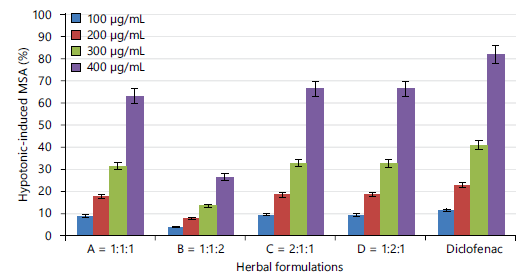
Hypotonicity-induced hemolysis of SRBC membrane of herbal formulation of Carica papaya, Azadirachta indica and Allium sativa (A-1:1:1, B-1:1:2, C-2:1:1 and D-1:2:1): Figure 1 illustrates the inhibitory effect of the herbal formulations on hypotonicity-induced hemolysis of the SRBC membrane, showing a clear dose-dependent increase across all samples. Formulations C (2:1:1) and D (1:2:1) demonstrated comparatively higher membrane stabilization than A and B, particularly at higher concentrations. Diclofenac showed the highest inhibition at all tested concentrations. At 400 μg/mL, maximum inhibition was observed, indicating enhanced membrane protection with increasing concentration.
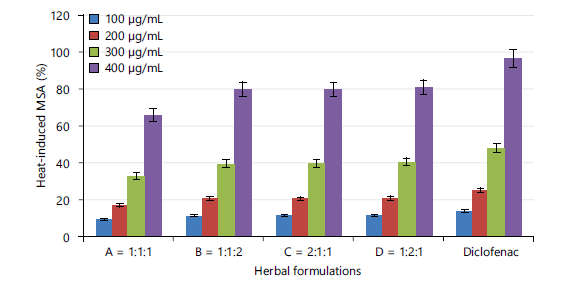
Heat-induced hemolysis of the SRBC membrane of herbal formulation of Carica papaya, Azadirachta indica, and Allium sativa (A-1:1:1, B-1:1:2, C-2:1:1, and D-1:2:1): The results shown in Fig. 2 of the anti-inflammatory activity of herbal mixtures at various concentrations protected the human RBC membrane against heat-induced lysis, as shown by the high percentage inhibition of RBC membrane hemolysis. At 400 μg/mL (higher) concentration, A-1:1:1, B-1:1:2, C-2:1:1, and D-1:2:1 exhibited 65.88., 79.78, 79.34 and 80.83% inhibition of SRBC hemolysis, respectively, compared with 96.23% inhibition produced by the same concentration of standard diclofenac.
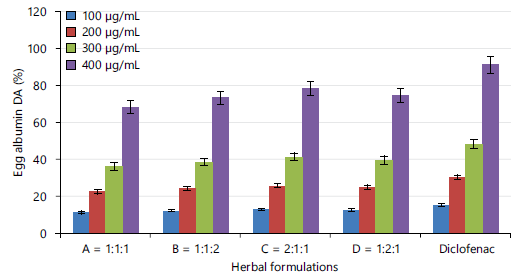
Egg albumin denaturation assay of herbal formulation of Carica papaya, Azadirachta indica, and Allium sativa (A-1:1:1, B-1:1:2, C-2:1:1 and D -1:2:1): Figure 3 demonstrates the inhibitory effect of the herbal formulations on albumin denaturation, showing a concentration-dependent increase across all samples. Formulations C (2:1:1) and D (1:2:1) exhibited higher inhibition compared to A and B. At 400 μg/mL, all formulations showed marked activity, with diclofenac exhibiting the highest inhibition. These findings indicate effective prevention of protein denaturation by the herbal mixtures.
|
|
|
DISCUSSION
In the investigation, the sheep Red Blood Cell (SRBC) method was utilized to evaluate in vitro anti-inflammatory property of the herbal formulations since erythrocyte membrane is similar to the lysosomal membrane, thus, its stabilization will imply that the herbal formulations may also stabilize lysosomal membranes21. The stabilization of the lysosomal membrane is critical for limiting the inflammatory response because it prevents the extracellular release of lysosomal contents of activated neutrophils which induce further tissue inflammation and damage. The present investigation showed that the herbal formulations have considerable anti-inflammatory properties demonstrated by the inhibition of SRBC membrane hemolysis. Generally, lysosomal membrane damage results in the release of phospholipase A2, which catalyzes the hydrolysis of phospholipids to generate inflammatory mediators21. On a contrary, the cell membrane stability prevents cell lysis and the release of cytoplasmic contents, thereby limiting tissue damage and mitigating inflammatory response. Consequently, compounds with membrane stabilization-enhancing activity are anticipated to significantly (p<0.05) protect the cell membrane against releasing such cell-damaging substances21, Anti-inflammatory agents can mediate this mechanism and prevent increasing membrane permeability22 as this could be the case in the present study since the herbal formulations showed appreciable inhibitory percentage in both heat- and hypotonic-induced stability.
Furthermore, protein denaturation can be avoided, thereby reducing inflammatory situations. The present study showed that the herbal formulations possess in vitro anti-inflammatory effect by decreasing protein denaturation as observed. According to Kpemissi et al.23, the presence of flavonoids and phenolic chemicals in plant extracts cause protein denaturation inhibition.
The inflammatory response is typically a difficult condition that is closely linked to discomfort during injury and pathogenic attack. It includes processes such as increased protein denaturation and cellular membrane rupture24,25. Many of the body's defense cells are activated when tissue cells are destroyed because signaling chemicals, including kinins, prostaglandins, and histamine are released. The efficacy of medicinal plants has already been tested in a number of studies involving protein denaturation associated with inflammatory processes26. The loss of tertiary and secondary structures brought on by a stressor such as heat, an organic solvent, a strong basic or acid, or a concentrated inorganic salt27 causes denaturation of proteins, which results in a loss of functionality28. Therefore, any substance that can stop protein denaturation has the potential to dramatically lower inflammation29. Furthermore, the primary cause of inflammatory and arthritic conditions is protein denaturation, which leads to the production of auto-antigens, which can start an auto-immune response and ultimately result in rheumatic arthritis30,31. Changes in disulfide, hydrogen, and electrostatic hydrophobic bonding are likely to result from the production of auto-antigens brought on by thermally induced protein denaturation30.
The potential of the herbal formulations to suppress protein denaturation in the current study was investigated and the results demonstrated that the herbal formulations considerably reduced protein denaturation (egg albumin). The ability of the herbal formulations to inhibit thermal and hypotonic protein denaturation is an indication its anti-inflammatory properties.The current finding supports a study by Joshi and Bharkatiya32, which found that a polyherbal formulation combining Allium sativa, Moringa oleifera, and Tinosporia cordifolia is an excellent source of physiologically active chemicals with potential anti-inflammatory properties. According to the study, the substantial presence of phenolic substances such as alkaloids, flavonoids, tannins, and steroids may be responsible for the anti-inflammatory properties. In vitro hemolysis was significantly inhibited by C. papaya extracts from partially developed leaves, according to Ranasinghe et al.33. At relatively lower concentrations (37.5 μg/mL), crude extracts of C. papaya leaves demonstrated an inhibitory action that was comparable to that of common anti-hemolysis drugs like aspirin and indomethacin. According to this experimental data, C. papaya leaf extracts may be useful in treating diseases that cause cellular membranes to become unstable. In a similar vein, Azadirachta indica lignocaine gel showed strong anti-inflammatory action in a variety of in vitro tests, successfully stabilizing proteins and cell membranes in a dose-dependent manner34.
Although no report was found on the herbal formulation of Carica papaya, Azadirachta indica, and Allium sativa, nevertheless, there are reports on in vitro anti-inflammatory potentials of the individual components (Carica papaya, Azadirachta indica, and Allium sativa) of the formulations.
CONCLUSION
The polyherbal mixtures of Carica papaya, Azadirachta indica, and Allium sativa demonstrated significant in vitro anti-inflammatory activity through inhibition of SRBC hemolysis and albumin denaturation. The effects were concentration-dependent, with formulations C (2:1:1) and D (1:2:1) showing comparatively higher efficacy. Although the activity was slightly lower than the standard drug (diclofenac), the results confirm the therapeutic potential of these herbal combinations. These findings support the possible use of such formulations as natural anti-inflammatory agents, warranting further in vivo and mechanistic investigations.
SIGNIFICANCE STATEMENT
This study shows that herbal mixture of Carica papaya, Azadirachta indica and Allium sativa possess in vitro ant-inflammatory activity. The present investigation reveals that the herbal mixture of Carica papaya, Azadirachta indica and Allium at different ratios and concentrations can be used to ameliorate membrane instability and protein denaturation in biological system.
REFERENCES
- Latif, R. and T. Nawaz, 2026. Medicinal plants and human health: A comprehensive review of bioactive compounds, therapeutic effects, and applications. Phytochem. Rev., 25: 2299-2342.
- Chaachouay, N. and L. Zidane, 2024. Plant-derived natural products: A source for drug discovery and development. Drugs Drug Candidates, 3: 184-207.
- Refaey, M.S., E.F. Abosalem, R.Y. El-Basyouni, S.E. Elsheriri, S.H. Elbehary and M.A.A. Fayed, 2024. Exploring the therapeutic potential of medicinal plants and their active principles in dental care: A comprehensive review. Heliyon, 10.
- Aravind, G., D. Bhowmik, S. Duraivel and G. Harish, 2013. Traditional and medicinal uses of Carica papaya. J. Med. Plants Stud., 1: 7-15.
- Dhakad, A.K., R. Kumar, R. Choudhary, S. Singh, S. Khan and P.K. Poonia, 2025. Traditional to modern perspectives on Neem (Azadirachta indica): A gateway to bioactive compounds, sustainable agrochemicals and industrial applications. Ind. Crops Prod., 231.
- Chaurasia, P.K., S.L. Bharati and S. Singh, 2024. Garlic against heart-related ailments: Chemistry, pharmacology, and future perspective. Mini-Rev. Med. Chem., 24: 521-530.
- Soares, C.L.R., P. Wilairatana, L.R. Silva, P.S. Moreira and N.M.M.V. Barbosa et al., 2023. Biochemical aspects of the inflammatory process: A narrative review. Biomed. Pharmacother., 168.
- Drina, M., 2017. Peptic ulcer disease and non-steroidal anti-inflammatory drugs. Aust. Prescriber, 40: 91-93.
- Chatterjee, P., S. Chandra, P. Dey and S. Bhattacharya, 2012. Evaluation of anti-inflammatory effects of green tea and black tea: A comparative in vitro study. J. Adv. Pharm. Technol. Res., 3: 136-138.
- Newman, D.J. and G.M. Cragg, 2020. Natural products as sources of new drugs over the nearly four decades from 01/1981 to 09/2019. J. Nat. Prod., 83: 770-803.
- Ahmed, M., M. Ji, A. Sikandar, A. Iram and P. Qin et al., 2019. Phytochemical analysis, biochemical and mineral composition and GC-MS profiling of methanolic extract of Chinese arrowhead Sagittaria trifolia L. from Northeast China. Molecules, 24.
- Prajapati, C., M. Ankola, T.K. Upadhyay, A.B. Sharangi and N.M. Alabdallah et al., 2022. Moringa oleifera: Miracle plant with a plethora of medicinal, therapeutic, and economic importance. Horticulturae, 8.
- Anosike, C.A., O. Obidoa and L.U.S. Ezeanyika, 2012. Membrane stabilization as a mechanism of the anti-inflammatory activity of methanol extract of garden egg (Solanum aethiopicum). DARU J. Pharm. Sci., 20.
- Dini, L., S. Mariano and E. Panzarini, 2019. Herbal Extracts from Carica papaya and Azadirachta indica: What Role for ROS in Cancer Cell Lines? In: Herbal Medicine: Back to the Future, Murad, F., Atta-ur-Rahman and K. Bian, Bentham Science Publishers, Sharjah, United Arab Emirates, ISBN: 978-981-14-1120-5, pp: 1-45.
- Ezeorba, T.P.C., K.I. Chukwudozie, C.A. Ezema, E.G. Anaduaka, E.J. Nweze and E.S. Okeke, 2022. Potentials for health and therapeutic benefits of garlic essential oils: Recent findings and future prospects. Pharmacol. Res. Mod. Chin. Med., 3.
- Pawase, P.A., C. Goswami, R. Shams, V.K. Pandey, A. Tripathi, S. Rustagi and G. Darshan, 2024. A conceptual review on classification, extraction, bioactive potential and role of phytochemicals in human health. Future Foods, 9.
- Patwardhan, B., 2005. Ethnopharmacology and drug discovery. J. Ethnopharmacol., 100: 50-52.
- Shinde, U.A., A.S. Phadke, A.M. Nair, A.A. Mungantiwar, V.J. Dikshit and M.N. Saraf, 1999. Membrane stabilizing activity—a possible mechanism of action for the anti-inflammatory activity of Cedrus deodara wood oil. Fitoterapia, 70: 251-257.
- Leelaprakash, G. and S.M. Dass, 2021. In vitro anti-inflammatory activity of methanol extract of Enicostemma axillare. Int. J. Drug Dev. Res., 3: 189-196.
- Chandra, S., P. Chatterjee, P. Dey and S. Bhattacharya, 2012. Evaluation of in vitro anti-inflammatory activity of coffee against the denaturation of protein. Asian Pac. J. Trop. Biomed., 2: S178-S180.
- Shan, Y., J. Zhao, K. Wei, P. Jiang and L. Xu et al., 2023. A comprehensive review of Tripterygium wilfordii hook. f. in the treatment of rheumatic and autoimmune diseases: Bioactive compounds, mechanisms of action, and future directions. Front. Pharmacol., 14.
- Umukoro, S. and R.B. Ashorobi, 2006. Evaluation of the anti-inflammatory and membrane-stabilizing effects of Eupatorium odoratum. Int. J. Pharmacol., 2: 509-512.
- Kpemissi, M., Y.T. Kantati, V.P. Veerapur, K. Eklu-Gadegbeku and Z. Hassan, 2023. Anti-cholinesterase, anti-inflammatory and antioxidant properties of Combretum micranthum G. Don: Potential implications in neurodegenerative disease. IBRO Neurosci. Rep., 14: 21-27.
- Dadoriya, P., Y.N. Dey, D. Sharma, M. Yadav, M.M. Wanjari, S.N. Gaidhani and V. Subhose, 2020. In-vitro anti-inflammatory and antioxidant activities of an Ayurvedic formulation -Trayodashang guggulu. J. Herb. Med., 23.
- Yuan, H.L., Y.L. Zhao, C.F. Ding, P.F. Zhu and Q. Jin et al., 2020. Anti-inflammatory and antinociceptive effects of Curcuma kwangsiensis and its bioactive terpenoids in vivo and in vitro. J. Ethnopharmacol., 259.
- Saleem, A., M. Saleem and M.F. Akhtar, 2020. Antioxidant, anti-inflammatory and antiarthritic potential of Moringa oleifera Lam: An ethnomedicinal plant of Moringaceae family. S. Afr. J. Bot., 128: 246-256.
- Kar, B., R.B.S. Kumar, I. Karmakar, N. Dola, A. Bala, U.K. Mazumder and P.K. Hadar, 2012. Antioxidant and in vitro anti-inflammatory activities of Mimusops elengi leaves. Asian Pac. J. Trop. Biomed., 2: S976-S980.
- Joshi, P., G.S. Yadaw, S. Joshi, R.B. Semwal and D.K. Semwal, 2020. Antioxidant and anti-inflammatory activities of selected medicinal herbs and their polyherbal formulation. S. Afr. J. Bot., 130: 440-447.
- Mouffouk, C., S. Mouffouk, K. Oulmi, S. Mouffouk and H. Haba, 2020. In vitro photoprotective, hemostatic, anti-inflammatory and antioxidant activities of the species Linaria scariosa Desf. S. Afr. J. Bot., 130: 383-388.
- Anokwah, D., E.A. Kwatia, I.K. Amponsah, Y. Jibira and B.K. Harley et al., 2022. Evaluation of the anti-inflammatory and antioxidant potential of the stem bark extract and some constituents of Aidia genipiflora (DC.) dandy (rubiaceae). Heliyon, 8.
- Das, K., S.M.B. Asdaq, M.S. Khan, S. Amrutha and A. Alamri et al., 2022. Phytochemical investigation and evaluation of in vitro anti-inflammatory activity of Euphorbia hirta ethanol leaf and root extracts: A comparative study. J. King Saud Univ. Sci., 34.
- Joshi, G.C. and M. Bharkatiya, 2022. In vitro anti-inflammatory activity determination of a polyherbal formulation containing Tinosporia cordifolia, Moringa oleifera and Allium sativum. J. Pharmacogn. Phytochem., 11: 96-105.
- Ranasinghe, P., P. Ranasinghe, W.P.K.M. Abeysekera, G.A.S. Premakumara, Y.S. Perera, P. Gurugama and S.B. Gunatilake, 2012. In vitro erythrocyte membrane stabilization properties of Carica papaya L. leaf extracts. Pharmacogn. Res., 4: 196-202.
- Divya, P.S.S. and R.A. Khallilur, 2025. Anti-inflammatory efficacy and embryotoxicity assessment of a novel Azadirachta indica-lignocaine gel using in vitro and zebrafish models for wound management. Test. Psychometrics Methodol. Appl. Psychol., 32: 1471-1475.
How to Cite this paper?
APA-7 Style
Abu,
M.S., Yakubu,
O.E., Tatah,
S.V., Danka,
Y.J. (2026). In vitro Evaluation of the Anti-Inflammatory Activity of Herbal Mixtures Containing Carica papaya, Azadirachta indica, and Allium sativa. Singapore Journal of Scientific Research, 16(1), 8-16. https://doi.org/10.3923/sjsr.2026.8.16
ACS Style
Abu,
M.S.; Yakubu,
O.E.; Tatah,
S.V.; Danka,
Y.J. In vitro Evaluation of the Anti-Inflammatory Activity of Herbal Mixtures Containing Carica papaya, Azadirachta indica, and Allium sativa. Singapore J. Sci. Res 2026, 16, 8-16. https://doi.org/10.3923/sjsr.2026.8.16
AMA Style
Abu
MS, Yakubu
OE, Tatah
SV, Danka
YJ. In vitro Evaluation of the Anti-Inflammatory Activity of Herbal Mixtures Containing Carica papaya, Azadirachta indica, and Allium sativa. Singapore Journal of Scientific Research. 2026; 16(1): 8-16. https://doi.org/10.3923/sjsr.2026.8.16
Chicago/Turabian Style
Abu, Michael, Sunday, Ojochenemi Ejeh Yakubu, Silas Verwiyeh Tatah, and Yab Jeremiah Danka.
2026. "In vitro Evaluation of the Anti-Inflammatory Activity of Herbal Mixtures Containing Carica papaya, Azadirachta indica, and Allium sativa" Singapore Journal of Scientific Research 16, no. 1: 8-16. https://doi.org/10.3923/sjsr.2026.8.16

This work is licensed under a Creative Commons Attribution 4.0 International License.
