
Central Composite Design Optimization of Friedel-Crafts Benzylation of Toluene over Fe3+/Zn2+-Doped Coconut Shell Biochar
-
Chima Maximus Ejimadu

Federal University of Petroleum Resources, Department of Science Laboratory Technology, Warri, Delta State, Nigeria
James Majebi OkuoUniversity of Benin, Department of Chemistry, Centre for Biomaterials Research, Benin City, Nigeria
Felix Ebhodaghe OkieimenUniversity of Benin, Department of Chemistry, Centre for Biomaterials Research, Benin City, Nigeria
| Received 24 Jul, 2026 |
Accepted 15 Sep, 2026 |
Published 21 Sep, 2026 |
Background and Objective: The Friedel-Crafts benzylation of toluene is an important industrial reaction for producing diarylmethanes, requiring efficient and environmentally benign heterogeneous catalysts. This study evaluated the catalytic performance of Fe3+/Zn2+ doped coconut shell biochar and optimized the reaction conditions using Response Surface Methodology (RSM) based on a Central Composite Design (CCD). Materials and Methods: Fe3+/Zn2+-doped coconut shell biochar was synthesized and applied as a heterogeneous catalyst for the Friedel-Crafts benzylation of toluene. Preliminary single-factor experiments were conducted to investigate the effects of the toluene-to-benzyl chloride stoichiometric ratio, reaction temperature, and catalyst loading. Subsequently, CCD was employed to optimize the reaction conditions and develop a quadratic polynomial model for predicting benzyl chloride conversion. Results: The quadratic model showed excellent agreement with the experimental data, with a coefficient of determination (R2) of 0.986. The optimized reaction conditions were a toluene chloride molar ratio of 16.71:1, a reaction temperature of 69.15°C, and a reaction time of 134.57 min, yielding a predicted benzyl chloride conversion of 91.64%. Experimental validation under the optimized conditions achieved a conversion of 93.01±1.68%, confirming the reliability and predictive capability of the developed model. Conclusion: Fe3+/Zn2+-doped coconut shell biochar is an effective heterogeneous catalyst for the Friedel-Crafts benzylation of toluene. Optimization using RSM-CCD successfully identified the optimum reaction conditions, and the developed quadratic model accurately predicted benzyl chloride conversion, demonstrating its potential for efficient process optimization and industrial application.
| Copyright © 2026 Ejimadu et al. This is an open-access article distributed under the Creative Commons Attribution License, which permits unrestricted use, distribution, and reproduction in any medium, provided the original work is properly cited. |
INTRODUCTION
Biochar is the carbon-rich product of slow pyrolysis of biomass in the absence of biomass in the absence of or limited oxygen atmosphere. The range of properties: Physicochemical, chemical and textural, properties, together with the larger mesoporous structure1,2 has made biochar a material of interest for diverse applications. In addition to its conventional application as sorbent for the removal of organic and inorganic contaminants from wastewater3 and in soil application for environmental remediation including carbon sequestration4 and agronomic benefits5, the innate chemistry of biochar (its chemical inertness, stability and tunability) has expanded the scope of potential application of biochar to industrial applications such as double capacitance data storage and catalysis6-9. A variety of carbon-rich materials; non-metallic heteroatom (N, P and B)-doped biochar metal (Fe, Zn, Mg etc.)-doped biochar and metal/heteroatom-doped biochar has been proposed and tested in heterogeneous catalysis10. For example, the effectiveness of metal-doped biochar as heterogenous catalyst for the transesterification and esterification of vegetable oils for the production of biodiesel has been reported by several workers11-15. There is however no report to the knowledge of the authors on the application of metal-doped carbon-rich materials in heterogeneous Friedel-Craft alkylation reactions. Friedel-Crafts reaction are important routes for the synthesis of substituted benzene16 that involved the conversion of C-H to C-C bonds and are used in the production of valuable commodity chemicals etc.17. Conventional homogeneous catalysts, H2SO4, HF, HCl, AlCl3 etc., used in Friedel-Craft synthesis through effective and are readily available at low cost, suffer from several drawbacks that include difficulty of separation of products (recovery and reverse), toxicity etc.18. Heterogenous solid acid catalysts that include zeolite, sulphonated polystyrene resins, mixed metal oxide, heteropoly acids etc., have over the years been developed as alternatives environmentally benign, stable and recyclable catalyst for Friedel-Crafts reactions19,20.
This project was designed and aimed at adding value to biomass with particular reference to coconut shell (Cocos nucifera L.) a co-by-product of coconut industry whose annual production worldwide is estimated to a exceed 120 million tons21. The waste products are often prodigiously dispersed into the environment or burnt in open-air causing environmental and public health concern22. Conversion of low cost biomass with little or no value into high value carbon rich materials has potential environmental, public health and economic benefits.
MATERIALS AND METHODS
Study area: The study was conducted at the Department of Chemistry, Faculty of Physical Sciences, University of Benin, which is located in Benin City, Edo State, Nigeria. It is approximate coordinates are 6°20'1"N Latitude and 5°36'1"E Longitude. This study was conducted over a period of 8 months, from July 2025 to March 2026.
Preparation of the catalyst: The Fe3+/Zn2+-doped coconut shell biochar catalyst used in this study as catalyst was prepared by the co-pyrolysis of coconut shell biochar under optimized conditions as described by Ejimadu et al.23. The properties; physicochemical, surface oxygen functional groups and textural of the optimized Fe3+/Zn2+-doped coconut shell biochar are given in Table 1.
All other chemicals used in this work were of analytical grade.
| Table 1: | Physico-chemical properties, surface oxygen functional groups and textural properties of the optimized Fe3+/Zn2+-doped coconut shell biochar | |||
| Metal doped biochar | |
| Physicochemical properties | Fe3+/Zn2+ |
| pH | 5.18±1.11 |
| Cation Exchange Capacity (cmoL/kg) | 29.14±1.29 |
| Bulk density (g/cm3) | 0.98±0.15 |
| Electrical conductivity (ms/cm) | 56.60±1.76 |
| Total oxygen functional groups (mmoL/g) | 1.47 |
| Textural properties | |
| SBET (m2/g) | 2124.48 |
| Pore diameter (nm) | 2.47 |
| Pore volume (cm3/g) | 0.77 |
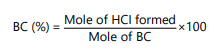
Catalytic activity of Fe3+/Zn2+-doped coconut shell biochar in Friedel-Crafts benzylation reaction: The effectiveness of the Fe3+/Zn2+-doped coconut shell biochar as catalyst in Friedel-Crafts benzylation of toluene was examined in preliminary experiment by varying one reaction condition and keeping others constant: (i) Varying stoichiometric ratio of toluene: Benzylchloride (T:BC) and keeping others conditions; reaction time, catalyst loading, reaction temperature and duration of reaction constant (ii) Varying catalyst loading and keeping other reaction conditions constant (iii) Varying reaction time and temperature of reaction and keeping other reaction conditions constant. In a typical experiment carried out in a continuously rector fitted with a condenser, mercury thermometer and arrangement for continuously bubbling moisture-free N2 gas at a constant rate, containing the catalyst material and toluene was added benzylchloride to start the reaction. The HCl involved from the reaction was carried by the N2 gas into a standard NaOH from which aliquots were withdrawn and titrated with standard HCl to the determine the extent of reaction. The conversion of benzyl chloride was calculated using Eq. 124:
 |
(1) |
Where:
| BC | = | Benzylchloride | |
| HCl | = | Hydrochloric acid |
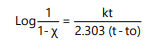
Kinetic study: The kinetics of the benzylation of toluene over the Fe3+/Zn2+-doped biochar catalyst were investigated at reaction temperatures of 50, 60 and 70°C. The experiments were conducted at a constant stoichiometric ratio of T:BC (15:1) and a catalyst loading of 8.2 wt% BC, while the reaction was monitored over a period of 0-180 min. The experimental conversion data were fitted to the pseudo-first-order kinetic equation, as expressed in Eq. 2:
 |
(2) |
where, kt is the rate constant for the pseudo-first-order reaction, χ is the conversion of benzylchloride, t is the reaction time and to is the induction period. The kinetic parameters were determined from the linearized form of the pseudo-first-order rate equation by plotting log versus time (t). The slope of the resulting linear plot was used to determine the pseudo-first-order rate constant, (kt), at each reaction temperature. The obtained rate constants were subsequently used to evaluate the temperature dependence of the benzylation reaction over the Fe3+/Zn2+-doped biochar catalyst.
Experimental design and optimization: The response surface methodology (RSM) based central composite design (CCD) was used to create the optimum synergy and to check the response patterns. The three independent variables chosen to optimize the benzylation of toluene reaction process were stoichiometric ratio of toluene: Benzylchloride (T:BC), reaction time and reaction temperature (Table 2) and benzylchloride conversion as response.
| Table 2: | Experimental range and level of independent variables | |||
| Coding | Level | |||
| Independent variables | -1 | 0 | 1 | |
| Mole ratio (T:BC) (moL/moL) | A | 5.0 | 10.0 | 20.0 |
| Reaction temperature (°C) | B | 55.0 | 67.5 | 80.0 |
| Reaction time (min) | C | 30.0 | 105.0 | 180.0 |
| T: Toluene and BC: Benzyl Chloride | ||||
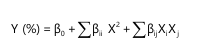
Central composite design model was used to fit the second order polynomial equation using a multiple regression programme according to Eq. (3) and Statistical Software Design Expert:
 |
(3) |
The regression analysis to estimate the response function at a second order polynomial was performed using a statistical software Design Expert II, Stat-Ease Inc. Minneapolis, USA.
The mathematical model (Eq. 3) was developed to predict the response (Y) as a function of the selected process variables (xi and xj). In this model, β0 represents the intercept, βi denotes the coefficients of the linear terms, βii corresponds to the quadratic terms, and βij accounts for the interaction effects between the independent variables. The parameter in indicates the total number of independent variables incorporated into the optimization. Analysis of Variance (ANOVA) was carried out to determine the adequacy of the model and the significance of each term in the model and to estimate the goodness of fit. Response surface were generated to determine the individual and interactive effects of the process variables on benzylchloride conversion.
RESULTS AND DISCUSSION
Effectiveness of Fe3+/Zn2+-doped biochar as catalyst in benzylation of toluene
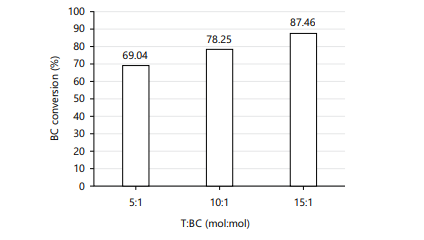
Effect of stoichiometric ratio of reactants: The effect of varying the stoichiometric ratio of toluene to benzylchloride on the extent of reaction (benzyl chloride conversion) is shown in Fig. 1. Generally stoichiometric ratio of reactants in Friedel-Crafts reactions is important as it determines the nature mono- or multi-substituted products.
It can be seen that a three-fold increase in the T:BC stoichiometric ratio (5:1-15:1) was accompanied by a progressive increase in the benzyl chloride conversion from 69.04% to 87.46%, representing a 26.68% relative increase in benzyl chloride conversion. The observed increase in benzyl chloride conversion with increasing T ratio indicates that the use of excess toluene favoured the benzylation reaction under the investigated conditions. The higher concentration of toluene relative to benzyl chloride increases the likelihood of interaction between toluene and the benzylating species generated on the Lewis acidic sites of the Fe3+/Zn2+-doped biochar catalyst. In addition, the large excess of toluene used in this study preclude the formation of multi-substituted products.
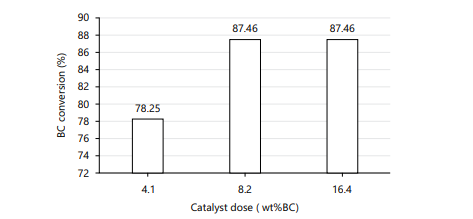
Effect of metal-doped biochar loading: The effect of various Fe3+/Zn2+-doped biochar loading on the conversion of benzylchloride is shown in Fig. 2.
|
|
|
It can be seen that within the range of catalyst loading (four-fold increase), benzyl chloride conversion increased by only 11.77%, from 78.25% at catalyst loading 4.1 wt% BC to 87.46% at catalyst loading 16.4 wt% BC. This reaction profile is typical of heterogeneous catalytic reactions, where an an initial increase in conversion with increasing catalyst loading is though to result from the increase in available active, thereby enhancing the interaction of the reactants with the catalyst surface. However, the increase in conversion was not proportional to the increase in catalyst loading, suggesting that possible factors such as mass-transfer limitations may have restricted the diffusion of reactants to accessible active sites within the catalyst particles25.
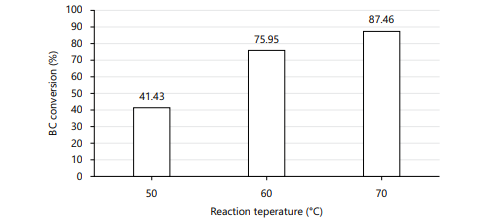
Effect of reaction temperature: The effect of reaction temperature on benzylchloride conversion is shown in Fig. 3. Benzyl chloride conversion was observed to increased from 41.43 to 87.46% as the reaction temperature increased from 50 to 70°C, representing relative increase of 83.32 and 15.00% between 50-60 and 60-70°C, respectively.
The greater magnitude of conversion observed at higher temperatures (Fig. 3) indicates that the benzylation reaction was greatly influenced by temperature-dependent reaction behavior, as increased temperature provides sufficient energy to overcome the activation energy barrier and promotes effective interactions between the reactants and the active sites of the Fe3+/Zn2+-doped biochar catalyst.
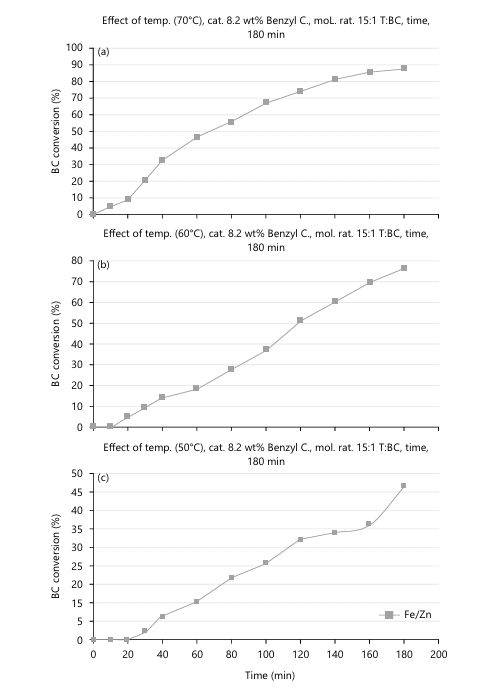
Effect of temperature on conversion rate of benzyl chloride: The effect of temperature on rate of conversion of benzyl chloride over the Fe3+/Zn2+-doped biochar catalyst monitored at T:BC stoichiometric ratio of 15:1, Fe3+/Zn2+-doped biochar catalyst of 8.2 wt% BC at different interval (0-180 min) is shown in Fig. 4(a-c).
|
| Table 3: | Variation of first-order rate constant and half-life with reaction temperature in the benzylation of toluene over metal-doped biochar catalyst | |||
| Reaction temperature (°C) | First order rate constant (min–1×10³) | Half life t(min) |
| 50 | 9.00 | 77.0 |
| 60 | 12.43 | 55.70 |
| 70 | 21.41 | 32.35 |
It can be seen (Fig. 4a-c) that the reaction profile of benzylation of toluene at various temperatures was characterized by temperature dependent induction period exceeding 15 min at 50°C. Increasing the reaction temperature shortened the induction period and accelerated conversion of benzylchloride conversion, indicating an increase in the reaction rate at higher temperatures. The conversion data obtained from Fig. 4 were further analysed using the pseudo-first-order kinetic model to determine the rate constants and half-lives, and the results are presented in Table 3.
|
| Table 4: | Experimental runs for friedel-crafts benzylation reaction over Fe3+/Zn2+-doped biochar catalysts | |||
| BC conversion (%) | ||||
| Mole ratio of T:BC (moL/moL) | Temp. (°C) | Time (min) | Actual | Predicted |
| 8.0/1.0 | 60.1 | 60.4 | 56 | 54 |
| 17.0/1.0 | 60.1 | 60.4 | 72 | 68 |
| 8.0/1.0 | 74.9 | 60.4 | 75 | 72 |
| 17.0/1.0 | 74.9 | 60.4 | 78 | 78 |
| 8.0/1.0 | 60.1 | 149.6 | 67 | 65 |
| 17.0/1.0 | 60.1 | 149.6 | 85 | 86 |
| 8.0/1.0 | 74.9 | 149.6 | 74 | 76 |
| 17.0/1.0 | 74.9 | 149.6 | 88 | 89 |
| 5.0/1.0 | 67.5 | 105 | 65 | 67 |
| 20.0/1.0 | 67.5 | 105 | 90 | 90 |
| 12.5/1.0 | 55 | 105 | 67 | 70 |
| 12.5/1.0 | 80 | 105 | 89 | 88 |
| 12.5/1.0 | 67.5 | 30 | 52 | 56 |
| 12.5/1.0 | 67.5 | 180 | 77 | 75 |
| 12.5/1.0 | 67.5 | 105 | 85 | 85 |
| 12.5/1.0 | 67.5 | 105 | 84 | 85 |
| 12.5/1.0 | 67.5 | 105 | 86 | 85 |
| 12.5/1.0 | 67.5 | 105 | 87 | 85 |
| 12.5/1.0 | 67.5 | 105 | 89 | 85 |
| 12.5/1.0 | 67.5 | 105 | 82 | 85 |
| BC: Benzyl chloride and T: Toluene | ||||
It can be observed in Table 3 that the pseudo-first-order rate constant increased from 9.00×10⁻³/ min at 50°C to 21.41×10⁻³/min at 70°C, while the half-life decreased from 77.0 to 32.35 min. The value of pseudo-fist-order rate constant reported in this study are lower than the values of 29.1×10⁻³ min reported for iron mesoporous molecular sieves26 and 33.40×10⁻³ min for nickel containing mesoporous silica27.
Optimization: The experimental runs were performed at different T:BC molar ratios, temperatures, and reaction times to assess their effects on BC conversion. As shown in Table 4, the actual BC conversion values ranged from 52 to 90%, while the predicted values ranged from 54 to 90%. The highest actual conversion (90%) was obtained at a T:BC ratio of 20.0:1.0, 67.5°C, and 105 min. The predicted values were generally close to the experimental results, indicating good agreement between the experimental and model-predicted values. This agreement supports the reliability of the developed model for predicting BC conversion.
| Table 5: | Summary of model statistic of benzyl chloride conversion over Fe3+/Zn2+-doped biochar | |||
| Source | Sequential p-value | Lack of Fit p-value | Adjusted R2 | Predicted R2 | |
| Linear | 0.0020 | 0.0041 | 0.516 | 0.3803 | |
| 2FI | 0.7464 | 0.0026 | 0.4562 | 0.1797 | |
| Quadratic | <0.0001 | 0.1620 | 0.9169 | 0.7369 | Suggested |
| Cubic | 0.1531 | 0.2473 | 0.9479 | 0.0559 | Aliased |
| Table 6: | Fit statistics for benzyl chloride conversion over Fe3+/Zn2+-doped biochar | |||
| Parameter | Fe3+/Zn2+-doped Biochar |
| Std. Dev. | 3.24 |
| Mean | 77.40 |
| C.V. % | 4.19 |
| Adeq Precision | 15.8043 |
| Table 7: | Anova of benzyl chloride conversion using Fe3+/Zn2+-doped biochar | |||
| Source | Sum of squares | Df | Mean square | f-value | p-value | |
| Model | 2301.56 | 9 | 255.73 | 24.3 | <0.0001* | Significant |
| A-Mole ratio | 633.92 | 1 | 633.92 | 60.24 | <0.0001* | |
| B-Temp. | 379.58 | 1 | 379.58 | 36.07 | 0.0001* | |
| C-Time | 412.37 | 1 | 412.37 | 39.18 | <0.0001* | |
| AB | 36.13 | 1 | 36.13 | 3.43 | 0.0936 | |
| AC | 21.13 | 1 | 21.13 | 2.01 | 0.1869 | |
| BC | 28.13 | 1 | 28.13 | 2.67 | 0.1331 | |
| A2 | 86.71 | 1 | 86.71 | 8.24 | 0.0167* | |
| B2 | 74.66 | 1 | 74.66 | 7.09 | 0.0238* | |
| C2 | 716.09 | 1 | 716.09 | 68.04 | <0.0001* | |
| Residual | 105.24 | 10 | 10.52 | |||
| Lack of Fit | 75.74 | 5 | 15.15 | 2.57 | 0.1620 | Not significant |
| Pure Error | 29.50 | 5 | 5.9 | |||
| Cor total | 2406.80 | 19 | ||||
| *Significant | ||||||
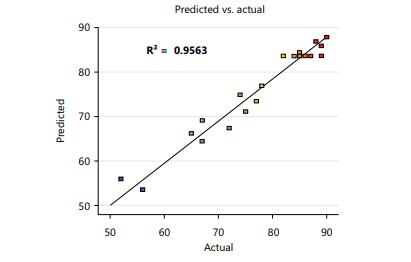
It can be seen from the results that the highest experimental (actual) value of 90% benzylchloride conversion was obtained under the experimental conditions stoichiometric T:BC ratio of 20:1, reaction temperature 67.5°C and duration of reaction 105 min. A plot of the results in Table 4 and shown in Fig. 5 indicate strong correlation between the actual and predicted values of the response (benzylchloride conversion) with R2 value of 0.9563.
The summary of model statistics (Table 5) indicate that the quadratic model with highest respective R2 values (Adjusted and Predicted) of 0.9169 and 0.7369 are in good agreement, differing by less than 20%28,29 was considered most suited to model the reaction (benzylation of toluene over Fe3+/Zn2+) process. The values of lack of fit for the quadratic model was found to be higher that 0.05 and provides additional support for the adoption of the model for further analysis of the experimental data.
The fit statistics for benzyl chloride conversion over Fe3+/Zn2+-doped biochar catalyst is present in Table 6. Coefficient of variation (CV) was found to be 4.19% and indicates that the variation and reproducibility of the model was appropriate for the prediction of benzylchloride conversion in the benzylation of toluene over Fe3+/Zn2+-doped biochar. The adequate precision value that represents signal to noise ratio28 was 15.80, and being greater that 4.0 indicate the model had adequate precision to navigate the design. The ANOVA results in Table 7 indicate that all the main linear factors: Stoichiometric toluene: Benzylchloride ratio (A), reaction temperature (B) and reaction time (C) with p-value<0.0001 showed significant effect on benzylchloride conversion. All the interaction factors, AB, AC and BC were found to have insignificant effect on the benzylation of toluene over Fe3+/Zn2+-doped biochar of quadratic factors, A2, B2 and C2 only C2 was found to have significant effect on the benzylation reaction.
Analysis of Variance (ANOVA) was carried out on the experimental data to determine the accuracy and significance of the experimental data. The results (Table 7) show that the model p-value is less than 0.0001 and suggests that there is a less than 0.05% chance that the large f-value of 24.30 that the model was significant.
|
The results show that the linear factors: (A) Stoichiometric toluene to benzylchloride ratio, (B) Reaction temperature, and (C) Duration of reaction with p-value<0.05 were significant in the benzylation of toluene over the Fe3+/Zn2+-doped coconut shell biochar; while the interactive term: AB, BC and AC and the quadratic terms; with p-value>0.05 were insignificant and all the quadratic term, A2, B2 and C2 were significant in the benzylation reaction of toluene over the Fe3+/Zn2+-doped biochar.
The evolved quadratic equation for benzylation of toluene over Fe3+/Zn2+-doped biochar after eliminating the significant terms is shown in Eq. 4:
BC conversion (%) = 85.44+6.81A±5.27B+5.50C-2.45A2-2.28B2-7.05C2 |
(4) |
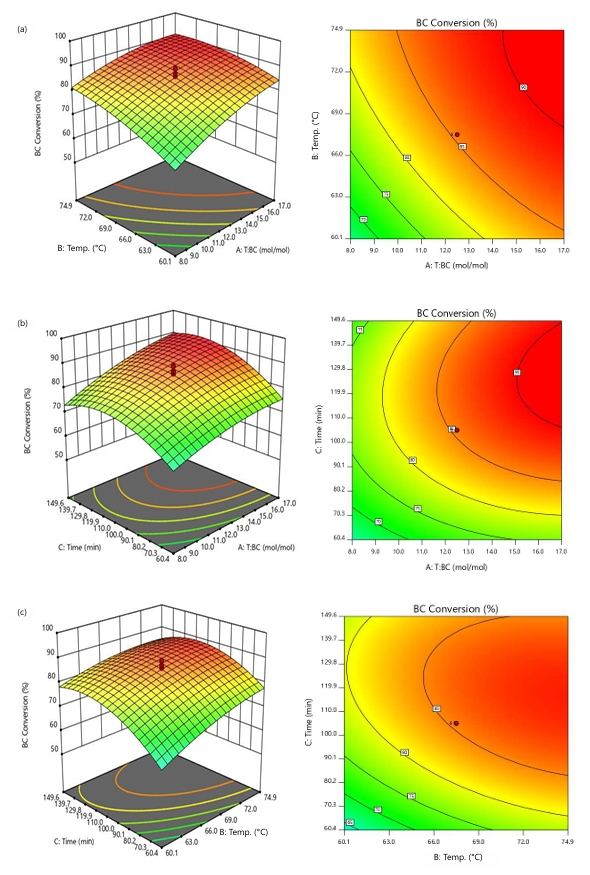
Response surface plots: Figure 6 shows a three-dimensional (3D) response surface diagram of the interaction effects of independent variable of benzylchloride conversion in the benzylation of toluene over Fe3+/Zn2+ doped coconut shell biochar. In 3D plot, two variables were changed and the third variable was kept constant at the zero coded level. The 3D plots are useful in providing useful information about the behavior of the system within the experimental design, facilitate an examination of the effects of the experimental on the factors and the contour plots behave on the factors30. Generally, the interactions among the factors are described by the shape of the contour lines; and the elliptic contour lines indicated significant interaction while the circular lines indicated insignificant interaction between corresponding variables31. The trends in benylchloride conversion against varying stoichiometric ratio of the reactants and temperature of reaction are shown in Fig 6a. The results indicate an increase in benzylchloride conversion with simultaneous increase in stoichiometric ratio of the reactants and reaction temperature. Similar trends can be observed from Fig. 6b and Fig. 6c where simultaneous increase in stoichiometric ratio of reactants and duration of reaction (Fig. 6b) and simultaneous increase in reaction temperature and reaction time (Fig. 6c) were accompanied with increase in benzylchloride conversion.
The response surface regression equation was used to obtain the optimum reaction variables for benzylation of toluene over Fe3+/Zn2+-doped coconut shell biochar. The optimal benzylchloride conversion 91.64% was obtained from the second order polynomial equation at stoichiometric ratio of reactants (T:BC) 16.79, reaction temperature 69.5°C and duration of reaction 134 min.
In order to verify the applicability of the model, validation experiments were carried out using the optimal benzylation reaction conditions. Benzylchloride conversion of 93.00±2.84% was in good agreement with the predicted value 91.64%.
CONCLUSION
In this study, the effectiveness of Fe3+/Zn2+-doped coconut shell biochar in Friedel-Crafts benzylation of toluene was demonstrated and the reaction process was optimized using the centra composite design of the response surface methodology. The application of Fe3+/Zn2+-doped coconut shell biochar in Friedel-Crafts alkylation reaction is novel. Pyrolytic conversion of low-cost coconut shell into metal-doped carb on rich material with potential multi-purpose applications has significance in circular economy.
SIGNIFICANCE STATEMENT
Fe3+/Zn2+-doped coconut shell biochar provides an efficient and sustainable heterogeneous catalyst for Friedel-Crafts benzylation of toluene. Response Surface Methodology effectively optimized the reaction conditions, achieving 93.01±1.68% benzyl chloride conversion. The findings demonstrate the potential of biomass-derived catalysts for greener and efficient industrial chemical processes.
REFERENCES
- Kong, S.H., S.K. Loh, R.T. Bachmann, S. Abdul Rahim and J. Salimon, 2014. Biochar from oil palm biomass: A review of its potential and challenges. Renewable Sustainable Energy Rev., 39: 729-739.
- Sharma, A., V. Pareek and D. Zhang, 2015. Biomass pyrolysis-a review of modelling, process parameters and catalytic studies. Renewable Sustainable Energy Rev., 50: 1081-1096.
- Inyang, M., B. Gao, P. Pullammanappallil, W. Ding and A.R. Zimmerman, 2010. Biochar from anaerobically digested sugarcane bagasse. Bioresour. Technol., 101: 8868-8872.
- Pradhan, S., A.H. Abdelaal, K. Mroue, T. Al-Ansari, H.R. Mackey and G. McKay, 2020. Biochar from vegetable wastes: Agro-environmental characterization. Biochar, 2: 439-453.
- Wang, J., Z. Li, Y. Li, Z. Wang, X. Liu, Z. Liu and J. Ma, 2024. Evolution and correlation of the physiochemical properties of bamboo char under successive pyrolysis process. Biochar, 6.
- Wei, L. and G. Yushin, 2011. Electrical double layer capacitors with activated sucrose-derived carbon electrodes. Carbon, 49: 4830-4838.
- Xu, B., Y. Chen, G. Wei, G. Cao, H. Zhang and Y. Yang, 2010. Activated carbon with high capacitance prepared by NaOH activation for supercapacitors. Mater. Chem. Phys., 124: 504-509.
- Chun, S.E. and J.F. Whitacre, 2012. The evolution of electrochemical functionality of carbons derived from glucose during pyrolysis and activation. Electrochim. Acta, 60: 392-400.
- Adorna Jr., J., M. Borines, van Dien Dang and R.A. Doong, 2020. Coconut shell derived activated biochar-manganese dioxide nanocomposites for high performance capacitive deionization. Desalination, 492.
- Bartoli, M., M. Giorcelli and A. Tagliaferro, 2023. A comprehensive overview on biochar-based materials for catalytic applications. Catalysts, 13.
- Chellappan, S., V. Nair, V. Sajith and K. Aparna, 2018. Synthesis, optimization and characterization of biochar based catalyst from sawdust for simultaneous esterification and transesterification. Chin. J. Chem. Eng. 26: 2654-2663.
- Dehkhoda, A.M. and N. Ellis, 2013. Biochar-based catalyst for simultaneous reactions of esterification and transesterification. Catal. Today, 207: 86-92.
- Cheng, F. and X. Li, 2018. Preparation and application of biochar-based catalysts for biofuel production. Catalysts, 8.
- Yuan, X., Y. Cao, J. Li, A.K. Patel and C.D. Dong et al., 2023. Recent advancements and challenges in emerging applications of biochar-based catalysts. Biotechnol. Adv., 67.
- Silvaraja, J., N.Y. Yahya, M.M. Zainol and Y.S. Lee, 2025. Preliminary investigations of sustainable magnetic catalyst-based biochar derived spent coffee ground for biodiesel production from waste cooking oil. Cleaner Chem. Eng., 11.
- Iqbal, A., K.H. Tan, U.S. Shaari, N.I.N.B. Ahmad and F. Adam et al., 2020. Friedel-crafts benzylation of toluene catalyzed by ZnCl2/SiO2 heterogeneous catalyst to para- and ortho-mono-benzylated toluene. J. Iran. Chem. Soc., 17: 1615-1626.
- Li, J., C. Xu, L.L. Lou, C. Zhang and K. Yu et al., 2013. Synthesis, characterization and catalytic properties of Fe-containing HMCM-68 for the benzylation of toluene. Catal. Commun., 38: 59-62.
- Anand, C., P. Srinivasu, S. Alam, V.V. Balasubramanian and D.P. Sawant et al., 2008. Highly active three-dimensional cage type mesoporous ferrosilicate catalysts for the Friedel-Crafts alkylation. Microporous Mesoporous Mater., 111: 72-79.
- Vinu, A., D.P. Sawant, K. Ariga, M. Hartmann and S.B. Halligudi, 2005. Benzylation of benzene and other aromatics by benzyl chloride over mesoporous AlSBA-15 catalysts. Microporous Mesoporous Mater., 80: 195-203.
- Singh, B.K., Y. Kim, S. Kwon and K. Na, 2021. Synthesis of mesoporous zeolites and their opportunities in heterogeneous catalysis. Catalysts, 11.
- Musa, A., B.S. Sani, F.B. Ibrahim and A.D. Adamu, 2021. Characterisation of magnetised and non-magnetised coconut shell biochars. Niger. Res. J. Eng. Environ. Sci., 6: 483-494.
- Sari, R.M., S. Gea, B. Wirjosentono, S. Hendrana and Y.A. Hutapea, 2020. Improving quality and yield production of coconut shell charcoal through a modified pyrolysis reactor with tar scrubber to reduce smoke pollution. Pol. J. Environ. Stud., 29: 1815-1824.
- Ejimadu, C.M., J.M. Okuo and F.E. Okieimen, 2026. Optimisation of process variables for preparation of magnetic carbon-rich materials using response surface methodology. Chem. Pap., 80: 4161-4177.
- Fogler, H.S., 2016. Elements of Chemical Reaction Engineering. 5th Edn., Prentice Hall, New Jersey, United States, ISBN: 978-0-13-388751-8, Pages: 992.
- Nandiwale, K.Y., P. Thakur and V.V. Bokade, 2015. Environmentally benign process for benzylation of toluene to mono-benzylated toluene over highly active and stable hierarchical zeolite catalyst. Appl. Petrochem. Res, 5: 113-119.
- Bachari, K., J.M.M. Millet, B. Benaı̈chouba, O. Cherifi and F. Figueras, 2004. Benzylation of benzene by benzyl chloride over iron mesoporous molecular sieves materials. J. Catal., 221: 55-61.
- Laribi, M., K. Bachari, R. Chebout and M. Touati, 2012. Synthesis, characterization and catalytic application of the nickel containing mesoporous silica. J. Assoc. Arab Univ. Basic Appl. Sci., 12: 42-47.
- Singh, R. and R. Bhateria, 2020. Optimization and experimental design of the Pb2+ adsorption process on a nano-Fe3O4-based adsorbent using the response surface methodology. ACS Omega, 5: 28305-28318.
- Niu, Y., W. Hu, T. Shen, K. Dong and D. Wang, 2022. Response surface methodology for the optimization of Zn-contaminated soil remediation by soil washing with water-soluble chitosan. ACS Omega, 7: 41929-41936.
- Panesar, P.S., 2008. Application of response surface methodology in the permeabilization of yeast cells for lactose hydrolysis. Biochem. Eng. J., 39: 91-96.
- Rajasimman, M. and P. Karthic, 2010. Application of response surface methodology for the extraction of chromium (VI) by emulsion liquid membrane. J. Taiwan Inst. Chem. Eng., 41: 105-110.
How to Cite this paper?
APA-7 Style
Ejimadu,
C.M., Okuo,
J.M., Okieimen,
F.E. (2026). Central Composite Design Optimization of Friedel-Crafts Benzylation of Toluene over Fe3+/Zn2+-Doped Coconut Shell Biochar. Singapore Journal of Scientific Research, 16(1), 44-55. https://doi.org/10.3923/sjsr.2026.44.55
ACS Style
Ejimadu,
C.M.; Okuo,
J.M.; Okieimen,
F.E. Central Composite Design Optimization of Friedel-Crafts Benzylation of Toluene over Fe3+/Zn2+-Doped Coconut Shell Biochar. Singapore J. Sci. Res 2026, 16, 44-55. https://doi.org/10.3923/sjsr.2026.44.55
AMA Style
Ejimadu
CM, Okuo
JM, Okieimen
FE. Central Composite Design Optimization of Friedel-Crafts Benzylation of Toluene over Fe3+/Zn2+-Doped Coconut Shell Biochar. Singapore Journal of Scientific Research. 2026; 16(1): 44-55. https://doi.org/10.3923/sjsr.2026.44.55
Chicago/Turabian Style
Ejimadu, Chima, Maximus, James Majebi Okuo, and Felix Ebhodaghe Okieimen.
2026. "Central Composite Design Optimization of Friedel-Crafts Benzylation of Toluene over Fe3+/Zn2+-Doped Coconut Shell Biochar" Singapore Journal of Scientific Research 16, no. 1: 44-55. https://doi.org/10.3923/sjsr.2026.44.55

This work is licensed under a Creative Commons Attribution 4.0 International License.
