
Emerging Trends in Alternative Energy Sources: A Review of Hydrogen, Bioelectrochemical Systems, and Advanced Biofuels
-
Clement Akutam Azure
Department of Physical Science, Faculty of Liberal Arts and Science, Eastern New Mexico University, Portales, New Mexico, USA
Saviour Tertindi TileDepartment of Chemical Engineering, Faulty of Engineering and Engineering Technology, University of Ilorin, Ilorin, Kwara State, Nigeria
Ifo Chike ValentineDepartment of Mechanical Engineering, Faculty of Engineering, Delta State University, Abraka, Delta State, Nigeria
Moses Abah Adondua

Department of Biochemistry, Faculty of Biosciences, Federal University Wukari, Taraba State, Nigeria
Micheal Oladosu AbimbolaDepartment of Chemical Sciences, Faculty of Science, Anchor University, Ayobo, Lagos State, Nigeria
Nathan Rimamsanati YohannaDepartment of Biochemistry, Faculty of Biosciences, Federal University Wukari, Taraba State, Nigeria
| Received 15 May, 2026 |
Accepted 31 Jul, 2026 |
Published 20 Aug, 2026 |
The increasing demand for sustainable energy and the urgent need to reduce greenhouse gas emissions have intensified global efforts to develop renewable alternatives to fossil fuels. Hydrogen, bioelectrochemical systems (BES), and advanced biofuels have emerged as promising technologies capable of supporting the transition toward a low-carbon and energy-secure future. This review critically examines recent developments in these alternative energy sources, highlighting their production technologies, environmental benefits, technical limitations, and prospects. Hydrogen is recognized as a clean energy carrier with high energy density and broad applications in transportation, power generation, and industrial processes. However, challenges related to cost-effective production, storage, transportation, and infrastructure development continue to limit its widespread adoption. Bioelectrochemical systems represent an innovative approach for simultaneous renewable energy generation and wastewater treatment, offering environmental and economic advantages. Nevertheless, their commercialization is constrained by low power output, limited scalability, and the high cost of electrode materials. Advanced biofuels, produced from lignocellulosic biomass, algae, and other non-food feedstocks, provide a practical solution for reducing greenhouse gas emissions while remaining compatible with existing fuel infrastructure. Despite these advantages, feedstock availability, conversion efficiency, and production costs remain significant challenges. Comparative analysis indicates that hydrogen is most suitable for long-term energy storage and industrial decarbonization; BES is particularly effective for decentralized waste-to-energy applications, and advanced biofuels provide an immediate pathway for decarbonizing the transportation sector. Overall, these technologies should be viewed as complementary rather than competing solutions. Continued research, technological innovation, supportive policy frameworks, and strategic investments are essential to overcome existing barriers and accelerate the deployment of sustainable energy systems capable of meeting future global energy demands while mitigating climate change.
| Copyright © 2026 Azure et al. This is an open-access article distributed under the Creative Commons Attribution License, which permits unrestricted use, distribution, and reproduction in any medium, provided the original work is properly cited. |
INTRODUCTION
The global energy landscape is undergoing a profound transformation driven by the urgent imperative to mitigate climate change. Rising atmospheric concentrations of greenhouse gases (GHGs), primarily carbon dioxide (CO2) from human activities, have led to unprecedented global temperature increases, extreme weather events, sea-level rise, and ecosystem disruptions. Fossil fuel combustion remains the dominant source of these emissions, with long-term dependency accelerating climate impacts and contributing to environmental degradation1. International efforts emphasize rapid decarbonization to limit warming, necessitating a shift from fossil fuel-dominated systems toward low- and zero-emission alternatives, where renewable energy and efficiency improvements play central roles2.
Despite progress, the transition remains incomplete, with the world often in an "energy addition" rather than full substitution mode. Fossil fuel demand has persisted at high levels, supported by established infrastructure and energy density advantages, yet this reliance exacerbates vulnerabilities including price volatility, supply disruptions, and geopolitical risks. Fossil fuels' inherent limitations are clear: They drive the majority of anthropogenic GHG emissions, impose severe health burdens through air pollution (e.g., respiratory and cardiovascular diseases), cause water and habitat contamination from extraction, and heighten energy security concerns in import-reliant regions as easily accessible reserves deplete3. Transitioning away is essential not only for environmental protection but also for economic resilience and reduced exposure to resource scarcity.
In response, alternative energy systems are emerging as critical pathways to decarbonize challenging sectors such as heavy industry, transport, and heating, while promoting diversified and often localized resources. Among promising options, hydrogen, bioelectrochemical systems (BES), and advanced biofuels offer versatility to bridge gaps where direct electrification faces barriers. Hydrogen stands out as a flexible, high-density energy carrier suitable for storage, long-distance transport, and direct applications in fuel cells or industrial processes, especially when produced sustainably via renewable-powered electrolysis (green hydrogen). It holds potential to supply clean energy across sectors difficult to electrify, with ongoing research highlighting production methods, storage challenges, and integration into power systems4,5.
Bioelectrochemical systems, such as microbial fuel cells (MFCs) and microbial electrolysis cells (MECs), utilize electroactive microorganisms to convert organic waste into electricity, biohydrogen, or other value-added products while enabling simultaneous wastewater treatment. These systems provide dual advantages of energy recovery and environmental remediation, with recent advances emphasizing scaling-up strategies, electrode enhancements, and improved efficiency for practical deployment6,7. Advanced biofuels, including third-generation types from microalgae or waste-derived pathways, offer drop-in compatibility with existing fuel infrastructure, particularly for aviation, shipping, and heavy transport. Sustainable aviation fuels (SAF) derived from algal biomass, hydrotreated oils, or gasification routes can deliver substantial lifecycle GHG reductions compared to conventional jet fuel, with research focusing on feedstock optimization, production efficiency, and sustainability certification8,9.
This review explores the emerging trends in these three alternative energy sources: Hydrogen, bioelectrochemical systems, and advanced biofuels. The aim is to evaluate recent technological advancements, production pathways, applications, key challenges (e.g., scalability, cost, efficiency), and their roles in supporting a sustainable, low-carbon energy future. By focusing on post-2020 developments, the paper captures accelerated innovations amid intensified climate urgency and policy momentum, while highlighting synergies, barriers, and opportunities for integrated implementation in the global energy transition.
Hydrogen energy technologies: Hydrogen energy technologies represent a cornerstone of the global shift toward sustainable, low-carbon energy systems, offering a versatile energy carrier capable of decarbonizing sectors where direct electrification is challenging, such as heavy industry, long-haul Dash et al.10, Louli et al.11, SMR: Steam methane reforming, ATR: Autothermal reforming, CCS: Carbon capture and storage, AEL: Alkaline electrolysis, PEM: Proton exchange membrane, SOE: Solid oxide electrolysis, CO2: Carbon dioxide, H2 = Hydrogen. Carbon intensity values represent approximate life-cycle emissions and may vary depending on feedstock, electricity source, carbon capture efficiency, and system boundaries. Efficiency values are indicative ranges based on current commercial and demonstration-scale technologies transport, and seasonal energy storage10. Hydrogen’s high energy density by weight (approximately 120-142 MJ/kg), clean combustion (producing only water when used in fuel cells), and compatibility with existing infrastructure adaptations position it as a key enabler for net-zero pathways. Recent advancements emphasize sustainable production, efficient storage, and scalable distribution to overcome historical barriers of cost, efficiency, and emissions11.
|
| Table 1: | Comparison of hydrogen production technologies | |||
| Technology | Feedstock | Process type | Carbon Intensity (kg CO2/kg H2) | Efficiency (%) | Maturity/ Status | Key advantages | Main challenges |
| Grey hydrogen | Natural gas | Steam methane reforming (SMR) | 12-Sep | 70-85 | Commercial (dominant) | Low cost, established infrastructure | High emissions, fossil-dependent |
| Blue hydrogen | Natural gas | SMR/ATR+CCS | 1-3 (with high capture) | 60-75 | Commercial/ scaling | Transitional low-carbon leverages gas | CCS costs/energypenalty, storage risks |
| Green hydrogen (AEL) | Water+renewables | Alkaline electrolysis | <1-2 (lifecycle) | 60-70 | Mature | Zero direct emissions, scalable | Lower efficiency, slower dynamics |
| Green hydrogen (PEM) | Water+renewables | PEM electrolysis | <1-2 (lifecycle) | 65-80 | Commercial/ growing | Fast response,compact | High catalyst costs |
| Green hydrogen (SOE) | Water+heat/renewables | Solid oxide electrolysis | <1-2 (lifecycle) | 80-90+ | Demonstration | High efficiency with heat integration | High-temperature durability issues |
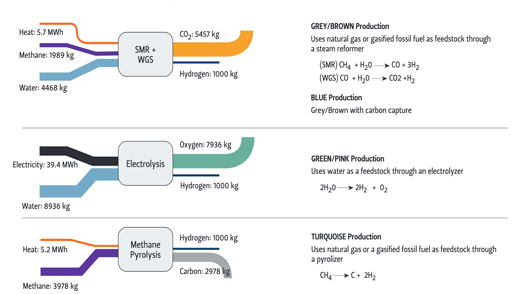
Hydrogen production pathways: Hydrogen production is classified by color based on feedstock, process, and associated carbon emissions. The dominant current method is grey hydrogen, produced primarily through steam methane reforming (SMR) of natural gas without carbon capture. In SMR, methane (CH4) reacts with steam at high temperatures (700-1000°C) in the presence of a nickel-based catalyst to yield hydrogen and carbon monoxide, followed by a water-gas shift reaction to convert CO to additional H and CO2. Grey hydrogen accounts for the majority of global production, but it emits approximately 9-12 kg CO2 per kg H2, making it highly carbon-intensive and incompatible with deep decarbonization goals12,13(Table 1).
Blue hydrogen builds on grey hydrogen by integrating carbon capture and storage (CCS) or utilization (CCU) to mitigate emissions (Fig. 1). Typically applied to SMR or autothermal reforming (ATR), blue pathways capture 80-95% of CO2 (often via amine-based absorption or advanced membranes), which is then compressed, transported, and stored in geological formations or used in applications like chemical synthesis. This reduces the carbon footprint to 1-3 kg CO2 per kg H2 (or lower with high capture rates), positioning blue hydrogen as a transitional low-carbon bridge toward fully renewable systems. Challenges include added capital costs (20-50% higher than grey), energy penalties for capture (reducing overall efficiency by 10-25%), and infrastructure needs for CO2 handling12.
Green hydrogen, produced via water electrolysis powered exclusively by renewable electricity (solar, wind, hydro), is the most environmentally benign pathway with near-zero direct emissions (typically <1-2 kg CO2-eq per kg H2 across the lifecycle when renewables dominate)14,15 (Table 1 and Fig. 1). Electrolysis splits water (H2O) into hydrogen and oxygen using electricity:
| • | Alkaline electrolysis (AEL): Mature, low-cost technology using KOH electrolyte and nickel electrodes; suitable for large-scale but lower efficiency (60*70%) and slower response to variable renewables16 | |
| • | Proton exchange membrane electrolysis (PEM): Higher efficiency (65-80%), faster dynamic operation, and compact design; ideal for coupling with intermittent renewables but more expensive due to platinum/iridium catalysts17 | |
| • | Solid oxide electrolysis (SOE): Emerging high-temperature option (700-900°C) achieving efficiencies >80% (often >90% with heat integration); leverages waste heat from industrial processes but requires further durability improvements17 |
Electrolysis efficiency and cost are improving rapidly, driven by declining renewable electricity prices and technological scaling. Other reforming processes, such as biomass gasification, offer niche renewable routes but remain less mature than electrolysis for green hydrogen13.
STORAGE AND DISTRIBUTION CHALLENGES
Hydrogen’s low volumetric energy density (0.09 kg/m3 at STP) necessitates compression (to 350-700 bar for vehicles), liquefaction (to -253°C for cryogenic storage/transport), or chemical binding (e.g., ammonia, liquid organic hydrogen carriers-LOHC) to enable practical storage and distribution12. Compressed gaseous storage is common for on-site or short-range use but requires high-strength materials (Type IV tanks with carbon fiber) to manage embrittlement risks and energy-intensive compression (10-15% of hydrogen’s energy content lost). Liquid hydrogen offers higher density for large-scale shipping but incurs boil-off losses (0.2-3% per day) and significant liquefaction energy (30-40% of energy content)13.
Pipeline distribution leverages existing natural gas networks with modifications (e.g., hydrogen blending up to 20% in some trials, or dedicated H pipelines), but challenges include material compatibility (hydrogen-induced cracking in steels), leakage risks due to small molecule size, and high upfront costs for new infrastructure. Alternative carriers like ammonia enable easier global shipping but require cracking back to H2, adding complexity and efficiency losses14.
|
Key barriers include high capital costs for storage/distribution (often 30-50% of total levelized cost of hydrogen), safety concerns (flammability, low ignition energy), and energy penalties that reduce overall system efficiency. Recent research focuses on advanced materials (e.g., metal hydrides, nanoporous adsorbents), underground storage in salt caverns or depleted fields, and hybrid approaches to minimize losses and costs15.
Bioelectrochemical systems (BES): Bioelectrochemical systems (BES) integrate microbial catalysis with electrochemical processes to convert organic substrates or waste into electrical energy, hydrogen, or value-added chemicals while enabling simultaneous wastewater treatment and resource recovery16. These systems harness electroactive microorganisms to transfer electrons from oxidation reactions at the anode to reduction reactions at the cathode, offering a sustainable platform for bioenergy production and environmental remediation. The BES encompasses microbial fuel cells (MFCs) for electricity generation and microbial electrolysis cells (MECs) for biohydrogen or other reduced products, with applications in waste valorization, biofuel synthesis, and circular economy strategies17.
Microbial fuel cells (MFCs): Microbial fuel cells (MFCs) generate electricity directly from the oxidation of organic matter by electroactive bacteria, such as Geobacter or Shewanella species, without requiring external power input. The principle relies on microbial extracellular electron transfer (EET) mechanisms at the anode, where bacteria oxidize substrates (e.g., acetate, glucose, or wastewater organics) and release electrons. These electrons flow through an external circuit to the cathode, producing electrical power while protons migrate through a separator (e.g., proton exchange membrane) to maintain charge balance18.
Electron transfer mechanisms in MFCs include:
| • | Direct electron transfer (DET): Via physical contact through outer membrane c-type cytochromes or conductive pili (nanowires) that facilitate electron conduction to the anode surface (from reviews on electrified biofilms in MFCs) | |
| • | Mediated electron transfer (MET): Involves soluble redox mediators (e.g., flavins, phenazines) shuttled between cells and the electrode | |
| • | Indirect mechanisms: Through conductive biofilms or extracellular polymeric substances enhancing electron hopping |
| Table 2: | Performance metrics of different BES configurations | |||
| BES type | Key configuration | Power density (W/m2 or mW/m2) | Current density (A/m2) | Coulombic efficiency (%) | Hydrogen production Rate (m3/m3·d) | Other Products/ Notes | Overview |
| MFC (Air- cathode) | Single-chamber, carbon cloth anode | 0.5-3 W/m2 | 15-May | 20-60 | N/A treatment | Wastewater MFC reviews focus | Comprehensive |
| MFC (Dual- chamber) | Proton exchange membrane | 1-6 W/m2 | 25-Oct | 40-80 | N/A | Higher efficiency with mediators | Materials and structures review |
| MEC (Biocathode) | Applied voltage 0.6-0.8 V | N/A | 20-May | 50-90 | 0.5-2.0 | H2 dominant, some CH4 co-production | MEC hydrogen production reviews |
| MEC (Abiotic cathode | Pt-catalyzed cathode | N/A | 30-Oct | 60-95 | 1.0-3.0 | Higher rates but costly catalysts | Agro-waste catalysts studies |
| MES (Microbial Electrosynthesis) | CO -fed cathode | N/A | 15-May | 40-80 | N/A | Acetate/formate/ ethanol up to 10-50 g/L | Cathode reduction product reviews |
| Sikarwar et al.7 | |||||||
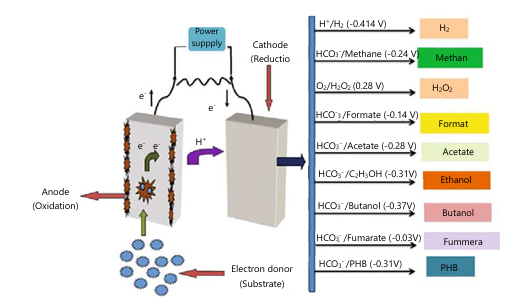
The anode reaction typically involves oxidation of organic compounds to CO , protons, and electrons (e.g., acetate: CH3COO–+2H2O→2CO2+7H++8e–). At the cathode, electrons reduce an acceptor, commonly oxygen in air-cathode MFCs (O2+4H++4e–→2H2O), generating power output. Performance depends on factors like electrode materials (carbon-based for cost-effectiveness), biofilm development, internal resistance, and substrate type. Recent advances focus on improving power density through nanostructured electrodes, mixed-culture inocula, and stacked configurations (Fig. 2)19.
The provided diagram illustrates a typical BES configuration, showing the anode compartment with substrate oxidation by microorganisms (electron donors like organic waste or acetate), electron flow to the cathode (facilitated by a power supply in MECs), and reduction products at the cathode. Key features include:
| • | Anode: Oxidation of substrate, releasing electrons and protons | |
| • | Cathode: Reduction reactions yielding H2, methane, formate, acetate, ethanol, butanol, fumarate, or PHB, with standard reduction potentials listed (e.g., H+/H2 at -0.414 V, HCO3–/methane at -0.24 V, HCO3–/formate at -0.41 V) | |
| • | External power input (for MECs) to overcome thermodynamic barriers for non-spontaneous reductions | |
| • | Proton migration and electron transport arrows |
This figure highlights the versatility of BES cathodes for electrosynthesis beyond electricity, aligning with microbial electrosynthesis principles where CO2 or organics are reduced to value-added compounds7.
Microbial electrolysis cells (MECs): Microbial electrolysis cells (MECs) extend MFC principles by applying a small external voltage (typically 0.2-1.0 V) to drive non-spontaneous reduction reactions at the cathode, enabling production of hydrogen or other reduced chemicals from organic waste. Unlike MFCs, which are limited to spontaneous reactions (e.g., oxygen reduction), MECs overcome thermodynamic barriers for hydrogen evolution or CO2 reduction16.
In MECs, anode oxidation mirrors MFCs (e.g., acetate oxidation), but the cathode uses the supplied electrons and protons for reductions such as:
| • | Hydrogen production: 2H++2e–→ H2 (theoretical potential -0.414 V vs. SHE at pH 7) | |
| • | Methane: HCO3–+8H++8e–→ CH4+3H2O | |
| • | Formate, acetate, ethanol, butanol, or polyhydroxybutyrate (PHB) via microbial electrosynthesis pathways involving homoacetogens or other electroactive microbes (Table 2) |
Cathode materials (e.g., carbon-based with catalysts like Ni or Pt) and biocathodes (enriched with hydrogenotrophic microbes) enhance efficiency. Hydrogen production rates in MECs reach 0.5-3 m3 H2 m–3 reactor d–1 in optimized lab systems, with energy recovery efficiencies up to 80-100% when coupled with waste treatment. Challenges include overpotentials, biofouling, and scaling, addressed through electrode modifications and hybrid configurations17.
Advanced biofuels: Advanced biofuels represent a critical pillar in the transition to sustainable transportation fuels, offering drop-in compatibility with existing engines and infrastructure while achieving substantial lifecycle Greenhouse gas (GHG) reductions compared to conventional fossil fuels17. Unlike first-generation biofuels derived from food crops, advanced biofuels utilize non-food feedstocks and advanced conversion technologies to minimize land-use competition, enhance energy security, and support circular economy principles18,19. These fuels, particularly second- and third-generation variants, target hard-to-decarbonize sectors such as aviation, shipping, and heavy-duty road transport, where electrification remains challenging.
Feedstocks: The choice of feedstock fundamentally determines the sustainability, scalability, and economic viability of advanced biofuel production. Lignocellulosic biomass stands out as the most abundant and widely studied second-generation feedstock, encompassing agricultural residues (e.g., corn stover, wheat straw, sugarcane bagasse), forestry by-products, energy crops (e.g., switchgrass, miscanthus), and municipal solid waste fractions20. These materials are rich in cellulose, hemicellulose, and lignin, which provide a high carbon content but require complex pretreatment to overcome their recalcitrant structure. Lignocellulosic feedstocks offer significant advantages: They are non-food, often available as low-cost waste streams, and can achieve up to 85-95% GHG emission reductions compared to fossil fuels when processed efficiently4. However, challenges include seasonal availability, collection logistics, and the high energy input needed for pretreatment.
Algae-based feedstocks represent the third-generation frontier, utilizing microalgae or macroalgae cultivated in open ponds, photobioreactors, or wastewater systems5. Algae exhibit exceptional biomass productivity (up to 10-50 times higher than terrestrial crops per unit area), do not compete with arable land, and can grow on non-potable water while sequestering CO2. Lipid-rich species (e.g., Chlorella, Nannochloropsis) are particularly valuable for biodiesel and renewable diesel production, while carbohydrate-rich strains support bioethanol or biogas pathways6. Algal systems also enable coproduction of high-value compounds such as omega-3 fatty acids, pigments, and animal feed, improving overall economics. Despite these benefits, large-scale cultivation faces hurdles related to high capital costs, water and nutrient demands, and contamination risks8.
Conversion technologies: Conversion technologies for advanced biofuels are broadly categorized into thermochemical and biochemical routes, each offering distinct advantages depending on feedstock characteristics and desired end products. Thermochemical processes operate at high temperatures and convert biomass directly into gaseous, liquid, or solid intermediates without relying on biological agents14. Gasification transforms lignocellulosic feedstocks into syngas (a mixture of CO and H2) through partial oxidation at 700-1200°C, followed by upgrading via Fischer-Tropsch (F-T) synthesis, methanol-to-gasoline (MTG), or water-gas-shift reactions to produce hydrocarbons, methanol, or hydrogen15. Pyrolysis and liquefaction thermally decompose biomass in the absence of oxygen to yield bio-oil, which can be hydrotreated to renewable diesel, jet fuel, or gasoline. These routes are robust, tolerate diverse feedstocks (including lignin-rich residues), and achieve high carbon efficiency, though they require significant energy input and sophisticated upgrading steps.
Biochemical routes, in contrast, employ enzymes and microorganisms to break down biomass under milder conditions. Hydrolysis of lignocellulosic biomass yields fermentable sugars (glucose, xylose), which are then fermented to ethanol, butanol, or other alcohols using genetically engineered yeasts or bacteria16.
| Table 3: | Types of advanced biofuels and their properties | |||
| Biofuel type | Primary feedstock | Conversion route | Energy density (MJ/kg) | GHG reduction vs. Fossil (%) | Drop-in Compatibility | Key advantages | Main challenges |
| Cellulosic ethanol | Lignocellulosic biomass | Biochemical (hydrolysis+ fermentation) | ~27 | 70-90 | High (blends with gasoline) | Mature technology, abundant feedstock | High pretreatment costs |
| Hydrotreated renewable diesel | Algae, waste oils, lipids | Thermochemical (hydroprocessing) | 42-44 | 80-95 | Excellent (full replacement) | Superior stability, no oxygen content | High hydrogen demand |
| Sustainable aviation fuel (SAF) | Algae, waste, lignocellulosics | Thermochemical (F-T, HEFA) | 42-43 | 80-95 | Excellent | Approved for commercial use | High production cost |
| Biojet (Alcohol-to-Jet) | Lignocellulosic sugars | Biochemical dehydration | 42-43 | 70-90 | Excellent | Uses existing ethanol infrastructure | Multi-step process |
| Biomethanol | Syngas from gasification | Thermochemical | ~20 | 60-85 | Moderate | Versatile chemical feedstock | Lower energy density |
| Biogas/ Hydrogen | Waste, lignocellulosics | Biochemical/ thermochemical | Variable | 80-100 | High (blending) | Carbon-negative potential | Distribution challenges |
| Sikarwar et al.7 and Stephy et al.8 | |||||||
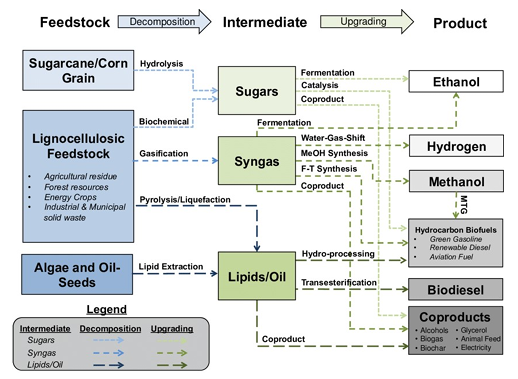
For lipid-based feedstocks such as algae, extraction followed by transesterification produces biodiesel, while hydroprocessing converts lipids into renewable diesel or sustainable aviation fuel (SAF) with superior cold-flow properties and stability17. Biochemical pathways are more selective and energy-efficient for sugar-rich feedstocks but are limited by pretreatment costs and inhibitor formation during hydrolysis (Fig. 3).
The diagram illustrates the integrated production pathways for advanced biofuels, starting from diverse feedstocks (sugarcane/corn grain, lignocellulosic biomass, algae/oil-seeds) and tracing decomposition to intermediates (sugars, syngas, lipids/oils) before upgrading to final products (ethanol, hydrogen, methanol, hydrocarbon biofuels, biodiesel, aviation fuel). Key flows include: Lignocellulosic feedstocks undergo hydrolysis or gasification/pyrolysis to sugars or syngas, which are upgraded via fermentation, F-T synthesis, or methanol synthesis. Algae lipids are extracted and processed through hydroprocessing or transesterification to renewable diesel and aviation fuel. Coproducts (alcohols, glycerol, biogas, biochar, animal feed) enhance economic viability. Dashed arrows indicate cross-pathway synergies (e.g., syngas to methanol or ethanol). The figure highlights the versatility of thermochemical and biochemical routes and the potential for integrated biorefineries that maximize product yield and resource efficiency6,13(Table 3).
| Table 4: | Sustainability indicators for hydrogen, BES, and biofuels | |||
| Technology/System | GWP (kg CO2-eq/unit)* | EROI (energy out/in) | Water Use (L/unit) | Land Use (m2/MJ) | Key Trade-offs |
| Grey hydrogen (SMR) | 10-15 /kg H2 | 15-25 | Low-medium | Low | High emissions, fossil lock-in |
| Blue Hydrogen (SMR+CCS) | 2-5 /kg H2 | 20-Oct | Medium | Low | CCS energy penalty, leakage risks |
| Green hydrogen (Electrolysis) | <1-2 /kg H2 | 15-May | High (electrolysis) | Low-medium | Water scarcity, material intensity |
| BES (MFC/MEC) | Low/negative (per kWh or m3 H2) | 8-Feb | Medium (wastewater) | Low | Electrode toxicity, scaling energy |
| Cellulosic ethanol | 20-50 g/MJ | 10-Apr | Medium-high | Medium-high | ILUC potential, pretreatment energy |
| Renewable Diesel/SAF | 10-40 g/MJ | 12-May | Medium-high | Medium | Feedstock competition, hydroprocessing H2 |
Sustainability and environmental assessment: Sustainability and environmental assessment of alternative energy sources hydrogen, bioelectrochemical systems (BES), and advanced biofuels are essential for ensuring their genuine contribution to a low-carbon future, beyond mere technical feasibility. Life cycle assessment (LCA) provides a comprehensive framework to evaluate the environmental impacts across the entire life cycle, from raw material extraction and production to use and end-of-life disposal. LCA quantifies indicators such as global warming potential (GWP), acidification, eutrophication, and resource depletion, revealing trade-offs that single-point an alyses often miss7. For hydrogen, LCA studies consistently show that production pathway dominates impacts: grey hydrogen from steam methane reforming without capture exhibits high GWP (around 10-15 kg CO2-eq/kg H2), while blue hydrogen with effective CCS reduces this to 2-5 kg CO2-eq/kg H2, though upstream methane leakage and CCS energy penalties persist as concerns. Green hydrogen via renewable-powered electrolysis achieves the lowest impacts (<1-2 kg CO2-eq/kg H2), but its footprint depends heavily on renewable electricity source, grid mix during off-peak, and electrolyzer manufacturing8 (Table 4).
In BES, LCA highlights dual benefits of energy recovery and waste treatment, with microbial fuel cells (MFCs) and microbial electrolysis cells (MECs) often yielding negative or low GWP when treating wastewater, as avoided conventional treatment emissions offset operational impacts. However, electrode materials (e.g., platinum catalysts in some configurations) and scaling energy demands can elevate resource depletion and toxicity categories9. Advanced biofuels demonstrate variable performance: Lignocellulosic ethanol and hydrotreated renewable diesel from waste or algae achieve 70-95% GWP reductions relative to fossil counterparts, driven by biogenic carbon uptake, but indirect land-use change (ILUC) for energy crops or high fertilizer inputs in algae cultivation can erode benefits10,11.
Energy return on investment (EROI), defined as the ratio of energy delivered to energy invested, serves as a key sustainability metric to assess net energy gain and long-term viability. High EROI (>10-20) indicates robust systems capable of supporting societal energy needs, while low values (<3-5) signal marginal or unsustainable options. Green hydrogen from wind or solar electrolysis typically yields EROI of 5-15, improving with scale and renewable integration, whereas grey hydrogen from natural gas often exceeds 20 due to established processes but carries high environmental costs7. For advanced biofuels, lignocellulosic pathways show EROI around 4-10, constrained by pretreatment and conversion efficiencies, while algal biofuels remain lower (2-6) owing to cultivation and harvesting energy demands6. BES systems, particularly MECs for biohydrogen, exhibit EROI values of 2-8 in optimized setups, benefiting from waste as "free" input but limited by low power/current densities and auxiliary energy needs5.
Environmental trade-offs further complicate deployment. While these alternatives reduce fossil fuel dependence and direct emissions, they introduce concerns such as water consumption (high for electrolysis and algae cultivation), land use (for biomass feedstocks), mineral resource depletion (rare earths in electrolyzers, platinum in BES cathodes), and biodiversity impacts from large-scale biomass sourcing or renewable infrastructure. For instance, green hydrogen production in water-scarce regions raises competition with agriculture, and SAF pathways from dedicated crops risk ILUC emissions offsetting climate gains10. BES offer wastewater remediation synergies but may generate secondary pollutants if not managed properly. Balancing these trade-offs requires holistic LCA and multi-criteria assessments to guide policy toward truly sustainable configurations, such as integrating BES with algal cultivation for nutrient recycling or co-locating green hydrogen with excess renewable capacity11,12.
CHALLENGES, POLICY, AND FUTURE PROSPECTS
Challenges, policy frameworks, and future prospects for hydrogen, bioelectrochemical systems (BES), and advanced biofuels are pivotal in determining their role in the global energy transition, as these technologies face multifaceted hurdles that must be addressed to achieve widespread adoption7. Economic barriers remain a primary impediment, with high production costs and scalability issues hindering commercialization. For hydrogen, levelized costs of production range from $3-8/kg for grey variants to $4-10/kg for green electrolysis, driven by capital-intensive electrolyzers, renewable electricity prices, and low utilization rates in variable renewable systems. Scalability is constrained by the need for gigawatt-scale facilities, where current deployments are largely pilot-level, exacerbating supply chain vulnerabilities for rare materials like iridium in proton exchange membrane electrolyzers8. The BES technologies encounter similar economic challenges, with capital costs for electrodes and reactors reaching $500-2000/m2, compounded by low power densities (0.5-3 W/m2 in MFCs) that limit energy recovery efficiency and make large-scale wastewater treatment applications uncompetitive without subsidies. Efforts to scale BES focus on modular designs and low-cost carbon materials, but operational instabilities from biofouling and microbial dynamics further inflate maintenance expenses9. Advanced biofuels face feedstock procurement costs ($50-150/ton for lignocellulosic biomass) and conversion inefficiencies, where enzymatic hydrolysis yields remain below 80%, leading to production costs of $0.8-1.5/L for cellulosic ethanol double that of fossil gasoline equivalents. Scalability is limited by biomass logistics and regional availability, requiring integrated biorefineries to achieve economies of scale10.
Infrastructure and policy gaps exacerbate these economic issues, as inadequate support structures delay deployment. Hydrogen requires extensive pipeline networks, storage facilities, and refueling stations, with current global infrastructure supporting only 5% of potential demand; retrofitting natural gas pipelines for hydrogen blending incurs costs of $0.5-2 million/km, while dedicated systems demand new investments amid safety concerns like embrittlement11. Policy inconsistencies, such as varying carbon pricing mechanisms and lack of harmonized standards for green hydrogen certification, create market uncertainty, with regions like Europe advancing through subsidies (e.g., EU Hydrogen Strategy allocating €5.2 billion) but others lagging in incentives for low-carbon variants12. For BES, infrastructure gaps include integration with existing wastewater plants, where retrofitting for electrode systems adds 20–50% to capital outlays, and policy frameworks often overlook dual benefits of energy recovery and pollution abatement, resulting in limited R&D funding compared to conventional biogas digesters13. Advanced biofuels suffer from fragmented supply chains for sustainable feedstocks and insufficient blending mandates; for instance, sustainable aviation fuel (SAF) mandates in the US (e.g., Inflation Reduction Act credits) drive progress, but global policy gaps in ILUC regulations and certification lead to uneven adoption, with production capacity at <1% of aviation fuel demand14.
Integration into existing energy systems presents both opportunities and complexities, necessitating hybrid approaches to leverage synergies while mitigating disruptions. Hydrogen can integrate as a storage medium for intermittent renewables, enabling sector coupling in power-to-gas schemes, but grid compatibility requires advanced control systems to manage variable injection rates, with efficiency losses of 20-40% in round-trip storage challenging economic viability15. BES integration offers promise in decentralized wastewater-energy hubs, where MECs could co-produce hydrogen with anaerobic digestion, recovering up to 50-90% of organic energy, yet microbial-electrochemical interfaces demand optimization to avoid voltage losses and ensure stable operation within industrial flows16. Advanced biofuels facilitate seamless integration via drop-in properties, blending up to 50% in diesel engines without modifications, but require upgrades in refining infrastructure for hydrotreatment and gasification, alongside policy-driven incentives to bridge the green premium gap of $0.2-0.5/L17. Future prospects hinge on technological breakthroughs, such as catalyst-free electrolysis for hydrogen, scalable 3D electrodes for BES, and genetically engineered algae for biofuels, potentially reducing costs by 30-50% by 2030. Strengthened policies, including carbon taxes, international trade agreements for green hydrogen, and R&D grants, could accelerate integration, fostering a symbiotic ecosystem where BES valorizes biofuel wastes and hydrogen powers biofuel processing21-24.
CONCLUSION
The study emphasizes the transformative potential of hydrogen, bioelectrochemical systems (BES), and advanced biofuels as synergistic components in the global energy transition towards net-zero emissions. Hydrogen is a great choice for a clean, high-density energy carrier, especially when it's made through renewable-powered electrolysis. This makes it possible to deeply decarbonize hard-to-abate sectors like heavy industry, long-haul transport, and seasonal storage. However, it is expensive to make, needs a lot of materials, and needs a lot of infrastructure. The BES technologies have a unique circular advantage because they can treat organic waste and make electricity or biohydrogen at the same time. This means that they have low or negative lifecycle emissions and can recover resources from wastewater more efficiently. However, they are still limited by low power densities, high electrode costs, and problems with scaling. Advanced biofuels can be easily added to existing fossil fuel infrastructure, and they can cut greenhouse gas emissions by 70-95% using lignocellulosic and algal feedstocks. However, they have to deal with problems with feedstock logistics, pretreatment inefficiencies, and possible indirect land-use effects. These technologies work together to fill important gaps where direct electrification isn’t possible, support integrated systems (for example, BES valorizing biofuel wastes and hydrogen powering biofuel upgrading), and make energy security better by using a wider range of resources, many of which are domestic. Even though there are economic, infrastructural, and policy barriers, their synergies, along with focused research on lowering costs, making them more scalable, and using hybrid configurations, make them necessary for a resilient, low-carbon energy future, as long as continued investment, policy alignment, and comprehensive life-cycle assessments guide their use.
SIGNIFICANCE STATEMENT
The significance of this study lies in its comprehensive evaluation of emerging alternative energy technologies hydrogen, bioelectrochemical systems, and advanced biofuels which are essential for decarbonizing sectors that are difficult to transition away from fossil fuels. By analyzing their unique advantages, limitations, and integration potential, the study provides critical insights for policymakers, researchers, and industry leaders aiming to accelerate the shift toward a secure, sustainable, and low-carbon energy future. This research highlights the importance of coordinated innovation, supportive policies, and resource management to maximize climate benefits while minimizing environmental trade-offs.
ACKNOWLEDGMENT
We thank all the researchers who contributed to the success of this research project.
REFERENCES
- Zandalinas, S.I., F.B. Fritschi and R. Mittler, 2021. Global warming, climate change, and environmental pollution: Recipe for a multifactorial stress combination disaster. Trends Plant Sci., 26: 588-599.
- Holechek, J.L., H.M.E. Geli, M.N. Sawalhah and R. Valdez, 2022. A global assessment: Can renewable energy replace fossil fuels by 2050? Sustainability, 14.
- Zhironkin, S. and F. Abu-Abed, 2024. Fossil fuel prospects in the energy of the future (Energy 5.0): A review. Energies, 17.
- Noyan, O.F., M. Mahmudul Hasan and N. Pala, 2023. A global review of the hydrogen energy eco-system. Energies, 16.
- Sadeq, A.M., R.Z. Homod, A.K. Hussein, H. Togun and A. Mahmoodi et al., 2024. Hydrogen energy systems: Technologies, trends, and future prospects. Sci. Total Environ., 939.
- Corona-Martínez, D.A., S.Y. Martínez-Amador, J.A.R. la Garza, E.I. Laredo-Alcalá and P. Pérez-Rodríguez, 2025. Recent advances in scaling up bioelectrochemical systems: A review. BioTech, 14.
- Sikarwar, D., I. Das, A. Ganta, I.M. Nambi, B. Erable and S. Das, 2025. Microbial electrolysis cells: Fuelling the future with biohydrogen-a review. Sustainable Chem. Environ., 9.
- Stephy, G.M., S. Surendarnath, G. Flora and K.T. T. Amesho, 2025. Microalgae for sustainable biofuel generation: Innovations, bottlenecks, and future directions. Environ. Qual. Manage., 34.
- Parise, M., 2025. Modeling non-quasi-static magnetic coupling of parallel flat inductors for wireless power transfer applications in close proximity to the ground. Energies, 18.
- Dash, S.K., S. Chakraborty and D. Elangovan, 2023. A brief review of hydrogen production methods and their challenges. Energies, 16.
- Louli, R., S. Giurgea, I. Salhi, S. Laghrouche and A. Djerdir, 2026. A critical review of green hydrogen production by electrolysis: From technology and modeling to performance and cost. Energies, 19.
- Xie, Z., Q. Jin, G. Su and W. Lu, 2024. A review of hydrogen storage and transportation: Progresses and challenges. Energies, 17.
- Sarker, M.T., M.H.S.M. Haram, S.J. Shern, G. Ramasamy and F. Al Farid, 2024. Second-life electric vehicle batteries for home photovoltaic systems: Transforming energy storage and sustainability. Energies, 17.
- da Silva Sousa, P., F.S. Neto, J. de França Serpa, R.K.C. de Lima and M.C.M. de Souza et al., 2024. Trends and challenges in hydrogen production for a sustainable energy future. Biofuels Bioprod. Biorefin., 18: 2196-2210.
- Worku, A.K., D.W. Ayele, D.B. Deepak, A.Y. Gebreyohannes, S.D. Agegnehu and M.L. Kolhe, 2024. Recent advances and challenges of hydrogen production technologies via renewable energy sources. Adv. Energy Sustainability Res., 5.
- Makepa, D.C. and C.H. Chihobo, 2024. Barriers to commercial deployment of biorefineries: A multi-faceted review of obstacles across the innovation chain. Heliyon, 10.
- Akram, F., T. Fatima, R. Ibrar and Ikram ul Haq, 2024. Biohydrogen: Production, promising progressions and challenges of a green carbon-free energy. Sustainable Energy Technol. Assess., 69.
- Al-Janabi, S.K., A.R. Barron, H.J.K. Shabbani, M.R. Othman and J. Kim, 2024. Advances in hydrogen production from sustainable resources through biological and thermochemical pathways: Review and bibliometric analysis. Int. J. Hydrogen Energy, 60: 28-45.
- Oliveira, M.L.M., C.M.A.C. Alves, C.F. Andrade, D.C.S. de Azevedo and F.L. Lobo et al., 2025. Recent progress and perspectives on functional materials and technologies for renewable hydrogen production. ACS Omega, 10: 3282-3303.
- Rojas-Flores, S.J., R. Liza, R. Nazario-Naveda, F. Díaz, D. Delfin-Narciso, M.G. Cardenas and A. Alviz-Meza, 2025. Next-generation biofuels from bioelectrochemical systems: A comparative review of CO2-derived products. Processes, 13.
- Chukwudi, O.Z., I.A. Mahmud, A.O. Idris, M.A. Abah, M.O. Abimbola and O.D. Agida, 2026. Advances in hydrogen, bioelectrochemical systems, and advanced biofuels for a low-carbon future. Chem. Environ. Sci. Arch., 6: 27-36.
- Abah, M.A., M.A. Oladosu, O.N. Oyibo, A.S. Ismail and B.C. Vaekosen et al., 2026. Isolation, identification and characterisation of toluene-tolerant bacteria from soil samples obtained from New Site Mechanic, Wukari, Taraba State, for bioremediation application. Microb. Sci. Arch., 6: 17-24.
- Yohanna, E.R., M.A. Abah, M.A. Oladosu, O.N. Oyibo and I.C. Christian et al., 2026. Production and characterization of pectinase from Aspergillus niger using orange peels as carbon source. J. Food Biotechnol., 7: 13-19.
- Nag, A. and D. Chaudhuri, 2026. Advances in nanomaterials for energy and sensing applications: From fundamentals to device. Discover Electron., 3.
How to Cite this paper?
APA-7 Style
Azure,
C.A., Tile,
S.T., Valentine,
I.C., Adondua,
M.A., Abimbola,
M.O., Yohanna,
N.R. (2026). Emerging Trends in Alternative Energy Sources: A Review of Hydrogen, Bioelectrochemical Systems, and Advanced Biofuels. Singapore Journal of Scientific Research, 16(1), 17-29. https://doi.org/10.3923/sjsr.2026.17.29
ACS Style
Azure,
C.A.; Tile,
S.T.; Valentine,
I.C.; Adondua,
M.A.; Abimbola,
M.O.; Yohanna,
N.R. Emerging Trends in Alternative Energy Sources: A Review of Hydrogen, Bioelectrochemical Systems, and Advanced Biofuels. Singapore J. Sci. Res 2026, 16, 17-29. https://doi.org/10.3923/sjsr.2026.17.29
AMA Style
Azure
CA, Tile
ST, Valentine
IC, Adondua
MA, Abimbola
MO, Yohanna
NR. Emerging Trends in Alternative Energy Sources: A Review of Hydrogen, Bioelectrochemical Systems, and Advanced Biofuels. Singapore Journal of Scientific Research. 2026; 16(1): 17-29. https://doi.org/10.3923/sjsr.2026.17.29
Chicago/Turabian Style
Azure, Clement, Akutam, Saviour Tertindi Tile, Ifo Chike Valentine, Moses Abah Adondua, Micheal Oladosu Abimbola, and Nathan Rimamsanati Yohanna.
2026. "Emerging Trends in Alternative Energy Sources: A Review of Hydrogen, Bioelectrochemical Systems, and Advanced Biofuels" Singapore Journal of Scientific Research 16, no. 1: 17-29. https://doi.org/10.3923/sjsr.2026.17.29

This work is licensed under a Creative Commons Attribution 4.0 International License.
